


NepalIsrael.com auto goggle feed
Up to 3.2 million people have been temporarily displaced in Iran since the start of the US-Israeli military campaign, the UN’s refugee agency estimates, a figure that is likely to rise as the war stretches into a third week.
While many Iranians have fled Tehran and other major cities to seek shelter in rural areas or the mountains to the north, millions remain in their homes in the capital despite regular airstrikes.
Nafise, a 30-year-old jewellery designer, is one of them. For privacy, she and all others interviewed are referred to by their first names only.
Nafise says her online business has slowed, at first because of January’s internet shutdown during anti-government protests and now again because of the war.
Together with her husband, Farhad, 33, she has renovated their apartment, stripping old wallpaper and repainting the walls. Picture frames of family and friends from holidays and trips now hang throughout, alongside Persian rugs.
It’s a cosy home in the heart of Tehran, close to metro stations and shops, flooded with warm light. It used to be quiet spot within the bustling capital, but now the sound of explosions is almost constant.
Last summer, Nafise and Farhad left Tehran briefly when Israel bombed Iranian military and nuclear sites. They would probably leave again, Nafise says, were it not for Sam and Yal, their cats.
“The trip was hard for them. They were terrified,” Nafise explains, sitting on the sofa with Sam purring on her lap.
Instead, the couple now spends most evenings with friends, moving between apartments across the city.
“Every night at eight, we gather at someone’s house. Everyone brings food or dessert to share. It helps keep the spirits up.”
Like many in her circle, Nafise says she hopes the regime will lose power, but she is equally clear about what she does not want.
“We don’t want this war. We want change, but not like this,” she says, adding:
“When people protested in January, it wasn’t because we supported Pahlavi,” she explains, referring to Reza Pahlavi, the US-based exiled son of Iran’s last shah, who has said he would be prepared to lead a transitional government for a new Iran if the Islamic Republic fell.
For a brief moment after the death of Ali Khamenei, Nafise says many around her believed the system might finally begin to unravel. But when his son, Mojtaba Khamenei, was chosen to succeed him, that hope quickly faded.
“The system is deep and complicated,” she adds. “Even if it changes one day, it won’t happen overnight, and it won’t happen with this war.”
Amir, 40, lives in Karaj but travels to the capital every day for work. He owns a small shop in southern Tehran and distributes brake pads. “The war and economic conditions directly affect my work,” he says. “My biggest concern is a prolonged war. But even if the war ends, many countries are not cooperating with Iran. If sanctions were lifted, the country could make significant progress. Our economy holds great potential.”
-
Abbas Agha works with Amir, 40 in a small shop distributing brake pads. Both stayed in the city, saying their biggest concern was a prolonged war and what this would mean for the already dire economy.
So far, at least 1,444 people have been killed in Iran while nearly 19,000 have been injured, the country’s state news agency reports. Iran has retaliated with strikes on US targets in the region, but a direct communications channel between the US special envoy, Steve Witkoff, and Iran’s foreign minister, Abbas Araghchi, has been reactivated in recent days, Axios reports.
The war has sent oil prices spiking to above $100 a barrel after Iran effectively closed the strait of Hormuz to the US, Israel and their allies.
The conflict has exposed deep divisions within Nato, with the UK and European governments making it clear they do not want to be drawn into the war.
Civilians in Tehran did not have that choice to make, said Vincent Cassard, head of the International Committee of the Red Cross in Tehran. “I am seeing the heavy strain that the recent escalation of hostilities has placed on people in Iran, who fear for their lives, the safety of their loved ones and their livelihoods,” he added.
“The heavy loss of life is alarming. Civilian infrastructure has been affected, and many homes have been severely damaged by the hostilities. Daily life in Tehran has been profoundly disrupted: children are not attending school, and many businesses have temporarily closed as a precaution due to the ongoing strikes.”
“Right now, not even residential homes are safe from attacks. We feel the shockwaves of blasts throughout the city,” says Mojtaba, a 30-year-old documentary film-maker.
Mojtaba’s home and office are in a Tehran basement, and since the start of the war, he has decided it is where he feels safest. He doesn’t want to leave, not even to visit his family on the city’s western outskirts. It is simply too dangerous.
He sits cross-legged on a wooden bench in his small, sheltered basement patio, a cigarette in his hand. The war has been stressful and smoking has helped him calm down.
“These days, I work late into the night, until I fall asleep. I’m usually woken up by an explosion. It makes my heart race. I try to guess the direction of the blast and whether it happened nearby or far away,” he says, adding that he refuses to give up hope. “Iran has seen many invasions throughout the centuries. We will make it this time too.”
Moen, a 14-year-old student, told the Guardian that he mostly stays at home, passing the time by reading or watching television: “It’s boring. I can’t see friends or go outside. I want to return to school.”
“I was in class when the war started, and we were sent home. Everyone was afraid, and nobody knows when school will resume,” he added.
-
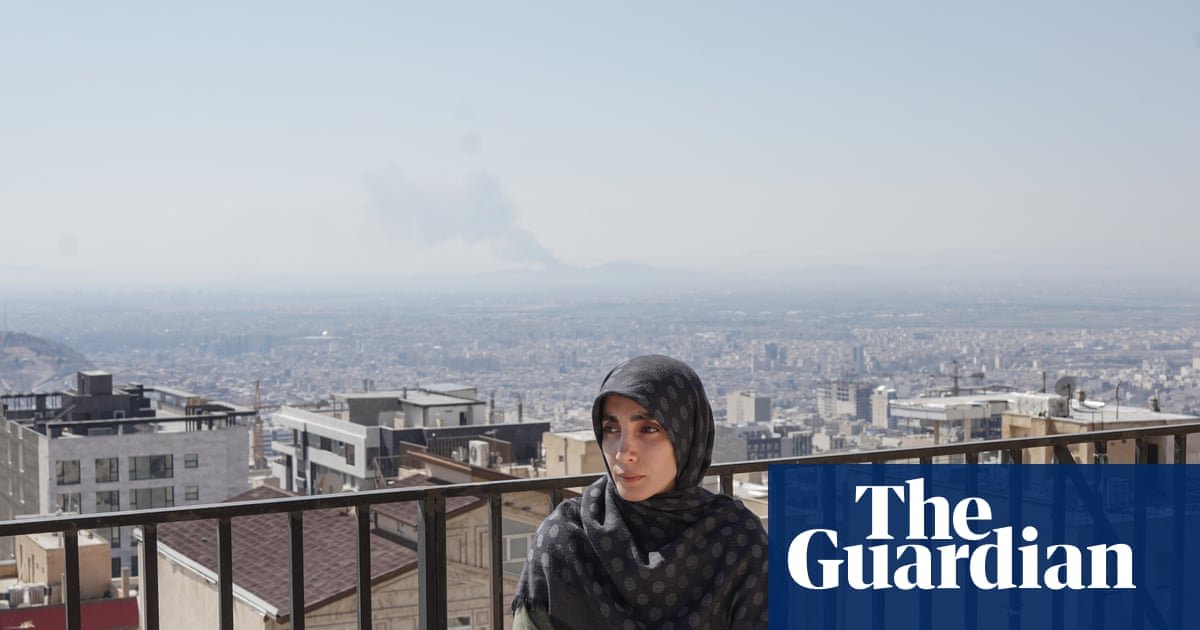
Asal, 35, a clothes designer, on her rooftop that overlooks the city.
Standing on her rooftop overlooking the city, Asal, a 35-year-old clothes designer who runs her own atelier, says she worries about the future and her job, but she is determined to stay in Tehran. “This is my home, and I’m not leaving, whatever the circumstances,” she explains.
Tehran is home to a large population of foreigners as well. There are 1.65 million Afghan refugees across the country and, as of late 2025, nearly 60,000 foreign students from 101 countries were studying at Iranian universities, according to the Tehran Times. Many live in the capital.
Ali, a Palestinian-Syrian man, is one of them. He has lived in Tehran for the past 10 years, pursuing a PhD in art research while also teaching at university. War is not new to him, but he prefers not to talk about his past. Still, he says witnessing so much conflict has, in a sense, numbed him. “It’s scary, but I feel like I am like a wall now,” he says. “This is what war can do to you.”
The post”‘We want change but not like this’: Iranians describe daily life under air attack | Iran” is auto generated by Nepalisrael.com’s Auto feed for the information purpose. [/gpt3]
