



NepalIsrael.com auto goggle feed
Settlers reportedly attack Palestinian villages as major West Bank settlement expansion set to be approved
Welcome to our live coverage of Israel’s war on Gaza. Several Palestinian people are reported to have been injured in an overnight attack by Israeli settlers in the southern West Bank village of Susya, south of Hebron, according to the Times of Israel. A man and his wife were reportedly injured in the attack and were taken to hospital to be treated.
Separately, Israeli settlers were reported to have attacked the village of Atara, also in the occupied West Bank, and set fire to several Palestinian-owned vehicles. There were no immediate reports of any casualties or arrests.
The attacks come amid a wave of violence in the West Bank, where more than 1,000 Palestinians are reported to have been killed by Israeli settlers and soldiers since 7 October 2023.
Accountability for settlers who commit acts of violence against Palestinians is extremely rare, particularly under Israel’s current rightwing government.

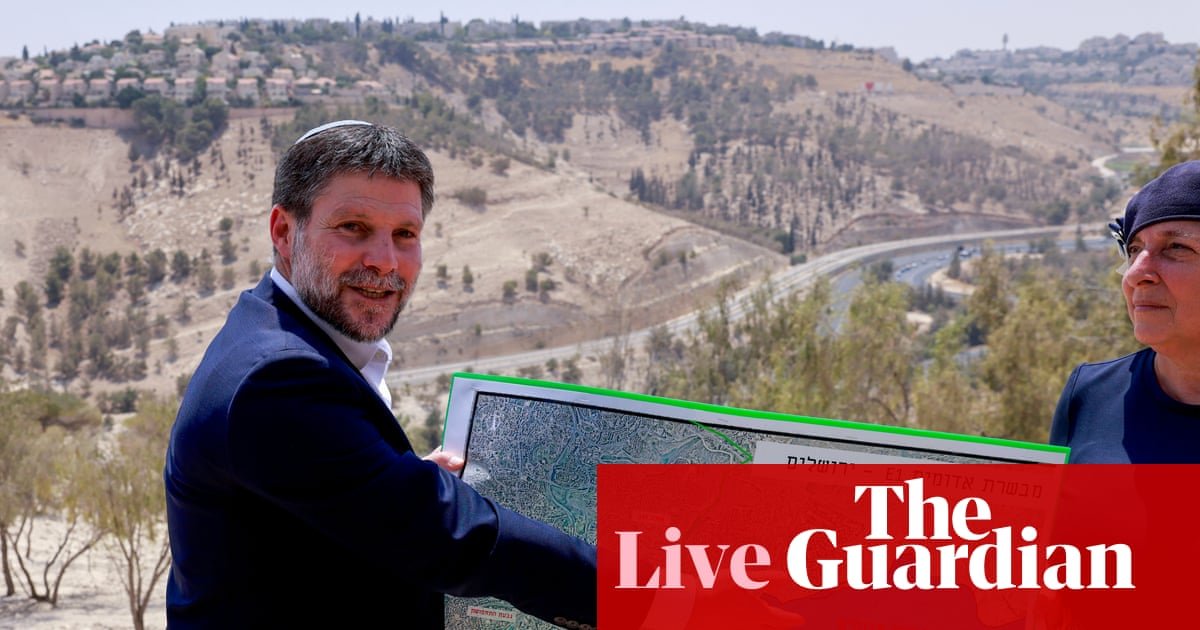
Israel’s far-right finance minister, Bezalel Smotrich, said on Thursday that about 3,400 new housing units would be built in key Israeli-occupied territory, effectively burying “the idea of a Palestinian state”.
As my colleague Peter Beaumont notes in this story, the so-called E1 plan would extend the existing Jewish settlement of Ma’ale Adumim towards Jerusalem, further cutting occupied East Jerusalem from the West Bank, and further separating the north and south of the territory. The plan still requires formal approval but it is expected to pass a final procedural hurdle, despite huge international opposition.
The announcement comes after some of Israel’s key western allies, such as Australia, Britain, Canada and France, pledged to soon recognise Palestinian statehood, under certain conditions, because of the humanitarian crisis Israel has caused in Gaza.
“This plan buries the idea of a Palestinian state,” Smotrich told journalists on Thursday.
Anyone in the world today who tries to recognise a Palestinian state will receive an answer from us on the ground. Not in documents, not in decisions or declarations – but in facts.
The plan was immediately condemned by the EU, among others. “The EU rejects any territorial change that is not part of a political agreement between involved parties. So annexation of territory is illegal under international law,” the European Commission spokesperson Anitta Hipper said.
Key events
Israel imposed a total aid blockade for 11 weeks starting in March (ostensibly to put pressure on Hamas to release hostages), and the trickle of food, fuel and medical supplies allowed in since May has not relieved extreme hunger.
Aid groups have said Israel’s blockade of humanitarian aid into the Gaza Strip is the principal cause of the famine unfolding across the territory.
When Israel allowed aid back in, it did so mostly under a contentious new aid delivery system – run by the Israeli-backed logistics group the Gaza Humanitarian Foundation. Israel says the new distribution system stops aid going to Hamas.
Aid trucks have been frequently rushed by desperate civilians, leading to chaotic scenes, but a USAID analysis published last month found no evidence of large-scale diversion of aid by Hamas.
At least 1,400 people have been killed while seeking aid since 27 May 2025, most of whom were killed near GHF sites, while other Palestinian people were killed along the routes of aid convoys, the UN has said.
Responding to a global outcry provoked by images of widespread starvation and malnutrition in Gaza, along with the regular killings of aid seekers by Israeli forces, the Israeli military increased the scale of aid allowed into the Strip at the end of last month.
But the amount of aid Israel allowed in is still totally inadequate for the humanitarian needs of Gaza’s two million population that is now experiencing catastrophic levels of famine, according to aid and human rights organisations, with widespread shortages of food and clean water.
Aid groups say Israel’s new registration rules are ‘weaponising aid’

Peter Beaumont
Peter Beaumont is a senior international reporter for the Guardian
More than 100 aid organisations working in the Gaza Strip and the West Bank have accused Israel of dangerously “weaponising aid” in its application of new rules for registering groups involved in delivering humanitarian assistance …
The letter, signed by organisations including Oxfam, Médecins Sans Frontières and Care, was written in response to registration rules announced by Israel in March that require organisations to hand over lists of their donors and Palestinian staff for vetting.
The groups contend that doing so could endanger their staff and give Israel broad grounds to block aid if groups are deemed to be “delegitimising” the country or supporting boycotts or divestment.
The registration measures were “designed to control independent organisations, silence advocacy and censor humanitarian reporting”, they said.
The letter added: “This obstruction has left millions of dollars’ worth of food, medicine, water and shelter items stranded in warehouses across Jordan and Egypt.”
You can read the full story here:
The Israel Defense Forces (IDF) said it launched an attack in the area of Khan Younis in the southern Gaza Strip and killed Nasser Musa, who it said was the head of Hamas’ military control department in the Rafah Brigade.
“Musa was responsible for the Rafah Brigade’s operational readiness & attacks during the war, and was a close associate of the brigade’s commander, Mohammad Sabaneh who was eliminated in May 2025,” the IDF wrote in an update on X.
The international court of justice last year issued a damning advisory opinion that said Israel’s presence in the occupied Palestinian territories was unlawful and called on it to end.
The judges pointed to a wide list of policies, including the building and expansion of Israeli settlements in the West Bank and East Jerusalem, use of the area’s natural resources, the annexation and imposition of permanent control over lands and discriminatory policies against Palestinian people, all of which it said violated international law.
The court said Israel had no right to sovereignty in the territories, was violating international laws against acquiring territory by force and was impeding Palestinians’ right to self-determination. It said Israel must end settlement construction immediately and that existing settlements must be removed.
Israeli prime minister Benjamin Netanyahu, who heads a coalition that includes far-right pro-settler parties and ministers, unsurprisingly denounced the nonbinding opinion, claiming the territories are part of the Jewish people’s historic homeland.
Israel captured the West Bank, East Jerusalem and Gaza Strip in the 1967 six-day war. It has annexed East Jerusalem in a move that is not recognised internationally and considers the West Bank to be disputed territory.
Here is some more detail on the controversial plan to significantly expand a settlement near occupied East Jerusalem:
The decision from the Supreme Planning Council, which meets next week, is expected to support the plan after rejecting objections by Israeli NGOs.
The expected decision in favour will come after Israel’s far-right finance minister, Bezalel Smotrich – who backs both the plan and the imposition of Israeli sovereignty through the occupied West Bank – gloated that he believed construction on E1 would “bury the idea of a Palestinian state”.
Smotrich is a junior minister who also holds a position at Israel’s defence ministry with oversight of planning issues in the occupied Palestinian territories. He was placed under sanctions along with fellow far-right minister Itamar Ben-Gvir by the UK, Canada, Australia and New Zealand in June for “repeated incitements of violence against Palestinian communities”.
Standing at the site of the planned settlement in Ma’ale Adumim on Thursday, Smotrich, a settler himself, said the Israeli prime minister, Benjamin Netanyahu, and US president, Donald Trump, had agreed to the revival of the E1 development, though there was no immediate confirmation from either.
While approval for the plan would be a significant step, it remained unclear on Thursday how much buy-in Smotrich has from Netanyahu and the Trump administration.
Netanyahu has not commented on Smotrich’s remarks, while the US state department appeared to dodge the issue of E1 when questioned.
Settlers reportedly attack Palestinian villages as major West Bank settlement expansion set to be approved
Welcome to our live coverage of Israel’s war on Gaza. Several Palestinian people are reported to have been injured in an overnight attack by Israeli settlers in the southern West Bank village of Susya, south of Hebron, according to the Times of Israel. A man and his wife were reportedly injured in the attack and were taken to hospital to be treated.
Separately, Israeli settlers were reported to have attacked the village of Atara, also in the occupied West Bank, and set fire to several Palestinian-owned vehicles. There were no immediate reports of any casualties or arrests.
The attacks come amid a wave of violence in the West Bank, where more than 1,000 Palestinians are reported to have been killed by Israeli settlers and soldiers since 7 October 2023.
Accountability for settlers who commit acts of violence against Palestinians is extremely rare, particularly under Israel’s current rightwing government.
Israel’s far-right finance minister, Bezalel Smotrich, said on Thursday that about 3,400 new housing units would be built in key Israeli-occupied territory, effectively burying “the idea of a Palestinian state”.
As my colleague Peter Beaumont notes in this story, the so-called E1 plan would extend the existing Jewish settlement of Ma’ale Adumim towards Jerusalem, further cutting occupied East Jerusalem from the West Bank, and further separating the north and south of the territory. The plan still requires formal approval but it is expected to pass a final procedural hurdle, despite huge international opposition.
The announcement comes after some of Israel’s key western allies, such as Australia, Britain, Canada and France, pledged to soon recognise Palestinian statehood, under certain conditions, because of the humanitarian crisis Israel has caused in Gaza.
“This plan buries the idea of a Palestinian state,” Smotrich told journalists on Thursday.
Anyone in the world today who tries to recognise a Palestinian state will receive an answer from us on the ground. Not in documents, not in decisions or declarations – but in facts.
The plan was immediately condemned by the EU, among others. “The EU rejects any territorial change that is not part of a political agreement between involved parties. So annexation of territory is illegal under international law,” the European Commission spokesperson Anitta Hipper said.
The post”Several Palestinian people reported injured in overnight attack by Israeli settlers in West Bank – Middle East crisis live | Middle East and north Africa” is auto generated by Nepalisrael.com’s Auto feed for the information purpose. [/gpt3]
