



NepalIsrael.com auto goggle feed
3 View gallery

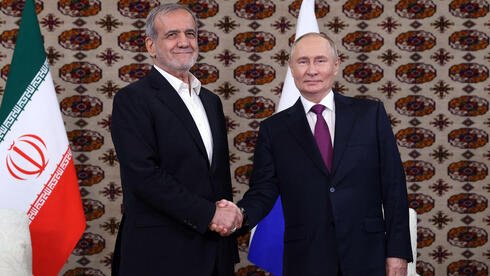
Iranian President Masoud Pezeshkian meeting with Russian counterpart Vladimir Putin
(Photo: alexander shcherbak/POOL/AFP)
The booking records include the men’s passport numbers with six of the seven having the prefix “20.” That denotes a passport used for official state business issued to government officials on foreign work trips and military personnel stationed abroad according to an edict published by the Russian government and a document on the Russian foreign ministry’s website.
Reuters was unable to determine what the seven were doing in Iran.
A Western defense official who monitors Iran’s defense cooperation with Russia and also requested anonymity said an unspecified number of Russian missile experts visited an Iranian missile base about 15 km (9 miles) west of the port of Amirabad on Iran’s Caspian Sea coast in September.
Reuters couldn’t establish if the visitors referred to by the officials included the Russians on the two flights.
The seven Russians identified by Reuters all have senior military backgrounds, with two ranked colonel and two lieutenant colonel, according to a review of Russian databases containing information about citizens’ jobs or places of work, including tax phone and vehicle records.
Two are experts in air defense missile systems, three specialize in artillery and rocketry, while one has a background in advanced weapons development and another has worked at a missile testing range, the records showed. Reuters was unable to establish whether all are still working in those roles as the employment data ranged from 2021 to 2024.

Reuters contacted all the men by phone. Five of them denied they had been to Iran, denied they worked for the military or both, while one declined to comment and one hung up.
Iran’s defense and foreign ministries declined to comment for this article, as did the public relations office of the Islamic Revolutionary Guard Corps, an elite force that oversees Iran’s ballistic missile program. The Russian defense ministry didn’t respond to a request for comment.
Cooperation between the two countries whose leaders signed a 20-year military pact in Moscow in January has already influenced Russia’s war on Ukraine with large numbers of Iranian-designed Shahed drones deployed on the battlefield.
Rockets and artillery
The flight booking information for the seven travelers was shown to Reuters by Hooshyaran e Vatan, a group of activist hackers opposed to the Iranian government. The hackers said the seven were traveling with VIP status.
Reuters corroborated the information with the Russian passenger manifest for the September flight which was provided by a source with access to Russian state databases. The news agency was unable to access a manifest for the earlier flight so couldn’t verify that the five Russian specialists booked on it actually made the trip.
Denis Kalko, 48, and Vadim Malov, 46, were among the five Russian weapons experts whose seats were booked as a group on the April flight the records showed.
Kalko worked at the defense ministry’s Academy for Military Anti-Aircraft Defense, tax records for 2021 show. Malov worked for a military unit that trains anti-aircraft missile forces according to car ownership records for 2024.
Andrei Gusev, 45, Alexander Antonov, 43, and Marat Khusainov, 54, were also booked on the April flight. Gusev, 45, is a lieutenant colonel who works as deputy head of the faculty of General Purpose Rockets and Artillery Munitions at the defense ministry’s Penza Artillery Engineering Institute according to a 2021 news item on the institute’s website. Antonov, 43, has worked at the Main Rocket and Artillery Directorate of the Defense Ministry according to car registration records from 2024 while bank data shows Khusainov, 54, a colonel has worked at the Kapustin Yar missile testing range.
The other passenger on the September flight was Oleg Fedosov, 46. Residence records give his address as the office of the Directorate of Advanced Inter-Service Research and Special Projects. That is a branch of the defense ministry tasked with developing weapons systems of the future.
Fedosov had previously flown from Tehran to Moscow in October 2023 according to Russian border crossing records viewed by Reuters. On that occasion, as he did for the September 2024 flight, Fedosov used his passport reserved for official state business, the records showed.
The post”Russian missile experts flew to Iran amid clashes with Israel” is auto generated by Nepalisrael.com’s Auto feed for the information purpose. [/gpt3]
