



NepalIsrael.com auto goggle feed
A New South Wales policing expert who participated in the Sydney rally against the Israeli president’s visit has called the police response “disappointing” and said violent clashes with protesters could have been prevented.
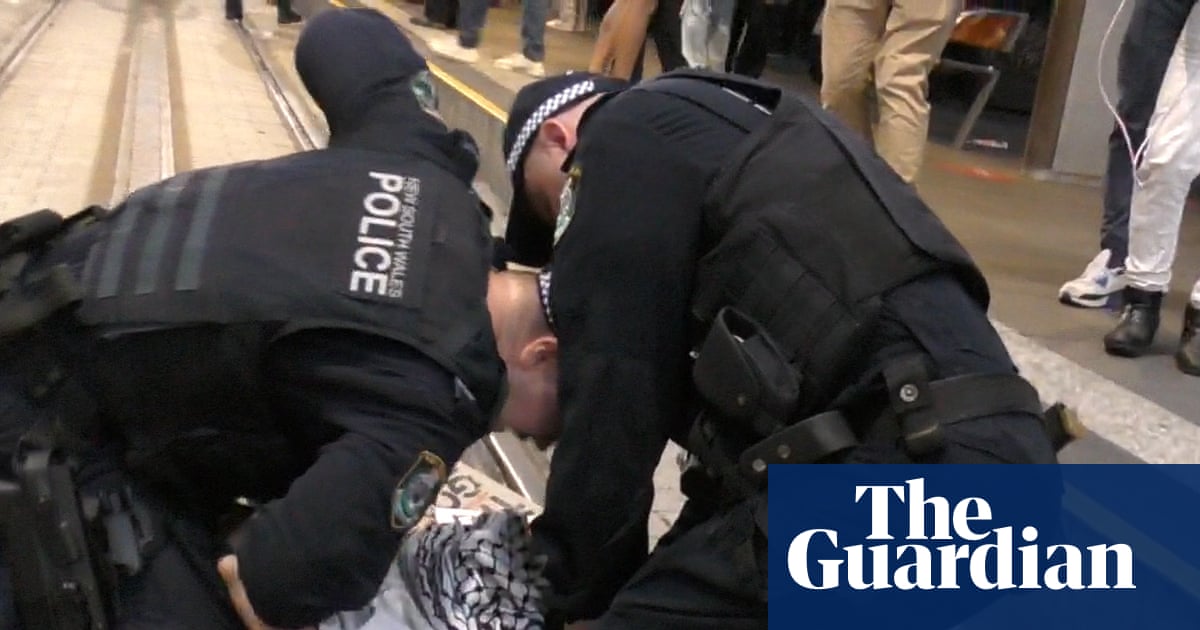
Dr Luke McNamara attended the protest outside town hall in the CBD on Monday to oppose Isaac Herzog’s Australian tour, from which footage emerged showing officers repeatedly punching protesters and using pepper spray at close range.
The premier, Chris Minns, on Tuesday called the response “proportionate” and defended controversial restrictions that gave police enhanced move-on powers and effectively banned protesters from marching from town hall to state parliament.
Sign up: AU Breaking News email
McNamara said the violence was, in his view, “the direct consequence” of the “unreasonable conditions” the government had imposed on the protesters that had “effectively quarantined” them inside a police containment line.
“When some of those present decided to push the limits of the police willingness to allow them to engage in a procession, it seems to me that’s when the confrontation started,” he said.
“Those events are likely never to have happened if police had permitted, indeed if the government had permitted, protesters to exercise their lawful right to protest.”
McNamara, who teaches at the University of NSW’s law faculty, said police should use physical force “extremely rarely” in protests and only when a crowd was out of control and perpetrating or threatening violence.
“That’s not what happened last night,” he said.
McNamara said he had watched footage of a man being repeatedly punched in the body by police, and of a group of praying Muslims being “dragged away” by officers.
He said there appeared to be “no reason” that level of force was necessary.
The premier has said police were “repeatedly confronted” by people attempting to breach the containment line and the officers shouldn’t be judged on “15-second social media posts” without the full context of each incident.
Associate Prof Dr Vicki Sentas, another policing expert at UNSW, said the available footage appeared to depict “a case study in disturbing and unnecessary police violence”.
She was also concerned that there had been “poor and dangerous crowd control”.
‘Lawful use of force’ questioned
While Sentas said each incident would need to be reviewed, overall the police response did not appear to meet the legal criteria for lawful use of force.
She said there were “credible allegations of excessive police force” and it would be appropriate for the NSW police watchdog, the Law Enforcement Conduct Commission (Lecc), to investigate.
The NSW police use of force manual, which outlines how and when officers can deploy weapons such as pepper or OC spray but also “hands on” forms of policing, is not publicly available.
But a copy of it was published in 2023 by the Lecc.
The manual states that police “should use no more force than is reasonably necessary to exercise your policing functions.
“You are personally responsible for any force you use and must be able to justify it,” the manual said.
“You must not use force to inflict punishment.”
Vincent Hurley, a former NSW police senior detective, said he would want to see what happened in the “30 seconds before” each clip of the violent clashes shared online before determining whether the use of force was excessive.
“It’s incredibly complex and it’s a no-win situation for anybody,” said Hurley, now a criminology lecturer at Macquarie University.
“On the surface of it … I think I can see how the police believed they were justified in using that force.”
A redacted NSW manual on pepper spray, released under Government Information Public Access (Gipa) laws in 2021, says using defensive sprays of the weapon may be used for “protection of human life”, as a “a less than lethal option for controlling people, where violent resistance or confrontation occurs (or is likely to occur)“, and protection against animals.
The use of force manual specifies “weaponless control” as an option for police, but does not specify what that control can involve. It can involve punches or strikes, which are sometimes designed to achieve compliance or distraction.
The manual also encourages police to constantly reassess their use of force, even in challenging circumstances.
“By the nature of their duties, police put themselves in harm’s way to deal with some of the most dangerous and reprehensible criminals.
“At times you will find it difficult to remain composed and considered in your actions.
“However, it is the role of the police to uphold the rule of law. You must do so with professionalism and integrity, treating people with decency and respect.”
‘A red mist of rage’
A recent court case considered how to assess whether the force used by a police officer was “reasonable”.
In 2018, four NSW police officers were involved in an incident in which a 16-year-old boy was tasered, hit with OC spray, and repeatedly struck with a baton.
One of the officers was charged with common assault after it was argued that six of the 18 times he struck the youth with a baton were not “reasonably necessary”.
A 2022 supreme court decision said the prosecution case was that the officer’s judgment had been clouded by a loss of self-control borne of frustration and anger, known in policing as “a red mist of rage”.
The officer, who left the force by the time of the hearing, argued that the contested baton strikes were a proportionate response to an outburst by the youth, who was drug affected, and was intended to bring him back under control with “pain compliance”.
The former officer was later cleared of the charge.
The post”Police use of violence ‘disturbing’ and ‘disappointing’ at Sydney rally against Israeli president, experts say | Sydney” is auto generated by Nepalisrael.com’s Auto feed for the information purpose. [/gpt3]
