



NepalIsrael.com auto goggle feed
For many Lebanese, the strikes between the Hezbollah militia and Israel feel like a return to war.
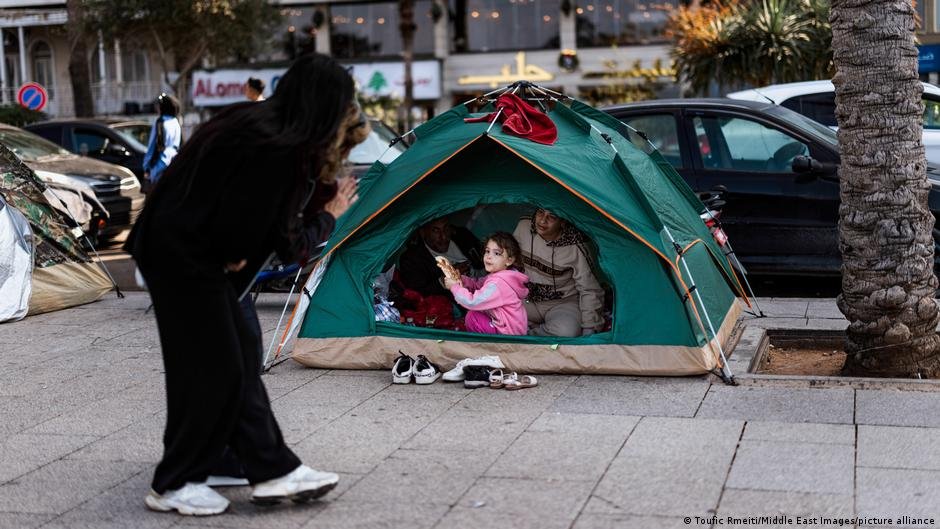
“I took my son and daughter and we fled from our house just before it was destroyed in an Israeli strike last week,” Rola Atwi, a 36-year-old mother from the Beirut suburb of Haret Hreik, told DW. Since then, the family has been staying on a sidewalk at a seaside neighborhood in west Beirut.
“My daughter has epilepsy and when loud sounds occur, she has seizures,” Atwi says. Protecting her children has become her sole priority. “I feel numb… nothing. I just want my daughter to be safe,” she said.
Lebanon was drawn into the Middle East war last week when the Iran-backed militant group Hezbollah started attacking Israel in response to the killing of Iranian supreme leader Ayatollah Ali Khamenei.
Since then, the situation has escalated on both sides of the Lebanese/Israeli border: Civilians in Israel have been under fire from Hezbollah as well as from Iran, yet civilian casualties in Israel appear limited due to the country’s defense systems and shelters.
In Lebanon, Israel’s attacks have triggered a large-scale humanitarian crisis. According to the Lebanese health authorities, 486 people had been killed, and around 1300 injured by Monday. The health ministry doesn’t distinguish between fighters and civilians.
The UN on Tuesday put the death toll higher, saying that 570 people had been killed and more than 750,000 people had been displaced.
Nearly 700,000 people have been displaced, according to UN agencies.
“Families already worn down by years of hardship are once again on the move, with thousands forced to sleep in cars and public spaces,” Suzanne Takkenberg, Beirut-based regional director for Lebanon at Action Against Hunger, told DW.
The renewed fighting effectively ends the fragile ceasefire between Hezbollah and Israel. In November 2024, a US-brokered deal ended 11 months of skirmishes and two months of war that killed around 4,000 people, and an Israeli ground invasion in Lebanon.
Hezbollah, whose military wing is classified as a terrorist organization by the US, Germany and many other countries, had started targeting Israel in a bid to support Hamas a day after the Hamas attack on Israel on October 7, 2023. Hezbollah is part of the Iran-led ‘Axis of Resistance‘, an alliance that includes groups in the Middle East that view Israel and the United States as enemies and call for their extinction.
Lebanon’s struggle with Hezbollah
On Tuesday, the Financial Times newspaper reported that Israel’s campaign against Hezbollah could continue even after the US-Israeli war with Iran ends.
Amid the unfolding humanitarian crisis, Lebanon’s politicians are bracing for extended fighting. On Monday, Lebanon’s parliament extended its term for two years. The parliamentary elections, originally scheduled for May this year, were postponed as the parliament considered it unrealistic to organize a national vote during times of war and large-scale displacement.
Earlier in March, the Lebanese government already outlawed all military and security activities by Hezbollah and highlighted that only the Lebanese state has the authority to decide matters of war and peace.
For the political analyst Ralph Baydoun, the political impact of outlawing Hezbollah is largely a “performative act about external signaling, rather than enforcement.”
“Hezbollah media speakers are still hosted on Lebanese TV channels, including anti-Hezbollah outlets,” the Beirut-based observer told DW.
“In addition, Hezbollah’s more than 20 years of control over the Lebanese state has allowed it to dig its heels in many sensitive judicial, security, and administrative positions, giving it leeway to maneuver around state decisions,” he points out.
Not only Hezbollah’s military but also its political arm is intertwined with Iran’s political and financial network, Baydoun adds.
Moreover, Lebanon’s government and the Lebanese Armed Forces, LAF, have long struggled to enforce disarmament of Hezbollah, as stipulated in the ceasefire in November 2024.
So far, Hezbollah has largely given up its weapons south of the Litani River but refuses to disarm altogether, citing the need to be able to defend the country against ongoing Israeli attacks and Israel’s military occupation of five points along the joint border. For its part, Israel has stated it will not stop targeting Hezbollah as long as it poses a threat.
“It is worth noting that Hezbollah never greenlighted LAF’s disarmament efforts and never permitted searches of positions not exposed by Israel,” Ralph Baydoun told DW, adding that the “six rockets that triggered the current conflict were launched from south of the Litani River.”
However, for Lebanese President Joseph Aoun, disarmament remains a key topic as it is also hinged to much-needed international investment for reconstruction of the damage from the previous war. At the time, the World Bank estimated reconstruction costs at some $11 billion (€9.5bn).
Disarmament through ground invasion?
The Israeli military called Tuesday on all residents of southern Lebanon to evacuate their homes saying it planned to “operate forcefully” in the southern area against Hezbollah. Observers, however, doubt that an Israeli ground invasion would actually lead to Hezbollah’s disarmament.
“Hezbollah is historically and practically more comfortable fighting a ground confrontation,” Sami Halabi, director of policy at the Beirut-based think tank The Alternative Policy Institute, told DW. “An Israeli ground invasion is more likely to entrench Hezbollah within Lebanon’s political and security landscape than to accelerate its disarmament,” he predicts.
Ralph Baydoun agrees. “A limited invasion would only strengthen Hezbollah’s cause, as resistance ideology only strengthens when land is occupied,” he told DW. “There is no real precedent of regime change being achieved through air campaigns alone,” Baydoun added.
Humanitarian situation worsens
The Lebanese population, who has been bearing the brunt of a series of economic and political crises since 2019, is meanwhile left vulnerable amid the renewed conflict between Hezbollah and Israel.
“In Lebanon there is a lack of shelter, basic services while rescue workers are being targeted, too,” Kelly Petillo, programme manager for Middle East and North Africa at the European Council on Foreign Relations, told DW.
In her view, the biggest challenge is finding ways to protect the entire population.
Abbass Saad, a 32-year-old Beirut resident, agrees. “We have no agency over this war,” he told DW. “I am young and ambitious,” he said, adding that “I don’t think being in a state of war since October 7 creates a good environment for the prospects of living here.”
Edited by: Jess Smee
The post”Lebanese brace as Hezbollah-Israel attacks escalate” is auto generated by Nepalisrael.com’s Auto feed for the information purpose. [/gpt3]
