



NepalIsrael.com auto goggle feed
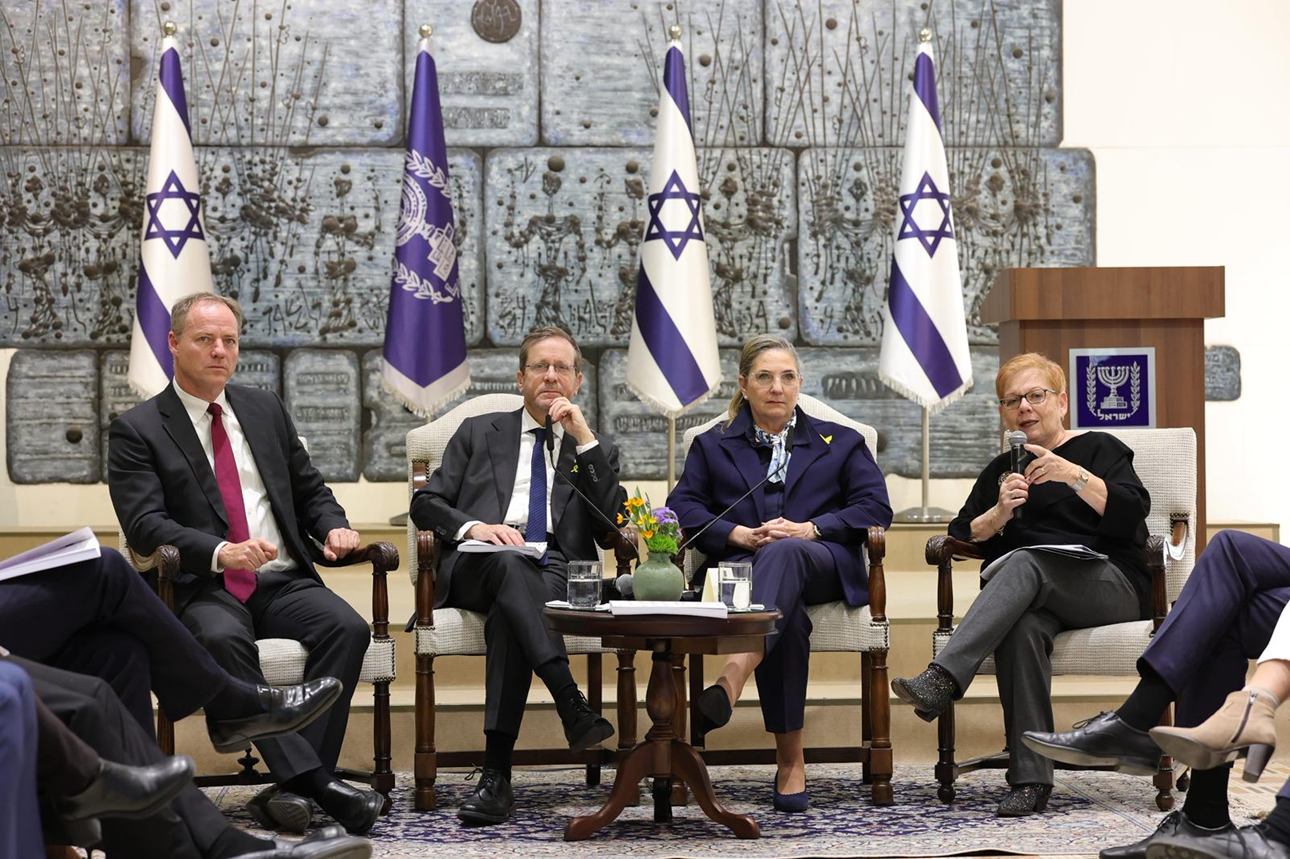
Photo by: Oded Karni
IDI’s 2025 Israeli Democracy Index: More positive assessments of the country’s overall situation, but there are low grades for Israeli democracy; public trust in the majority of institutions remains low; and the friction between Right and Left is viewed as the most acute social tension in Israel. Despite this, most Israelis prefer to remain in Israel rather than moving abroad.
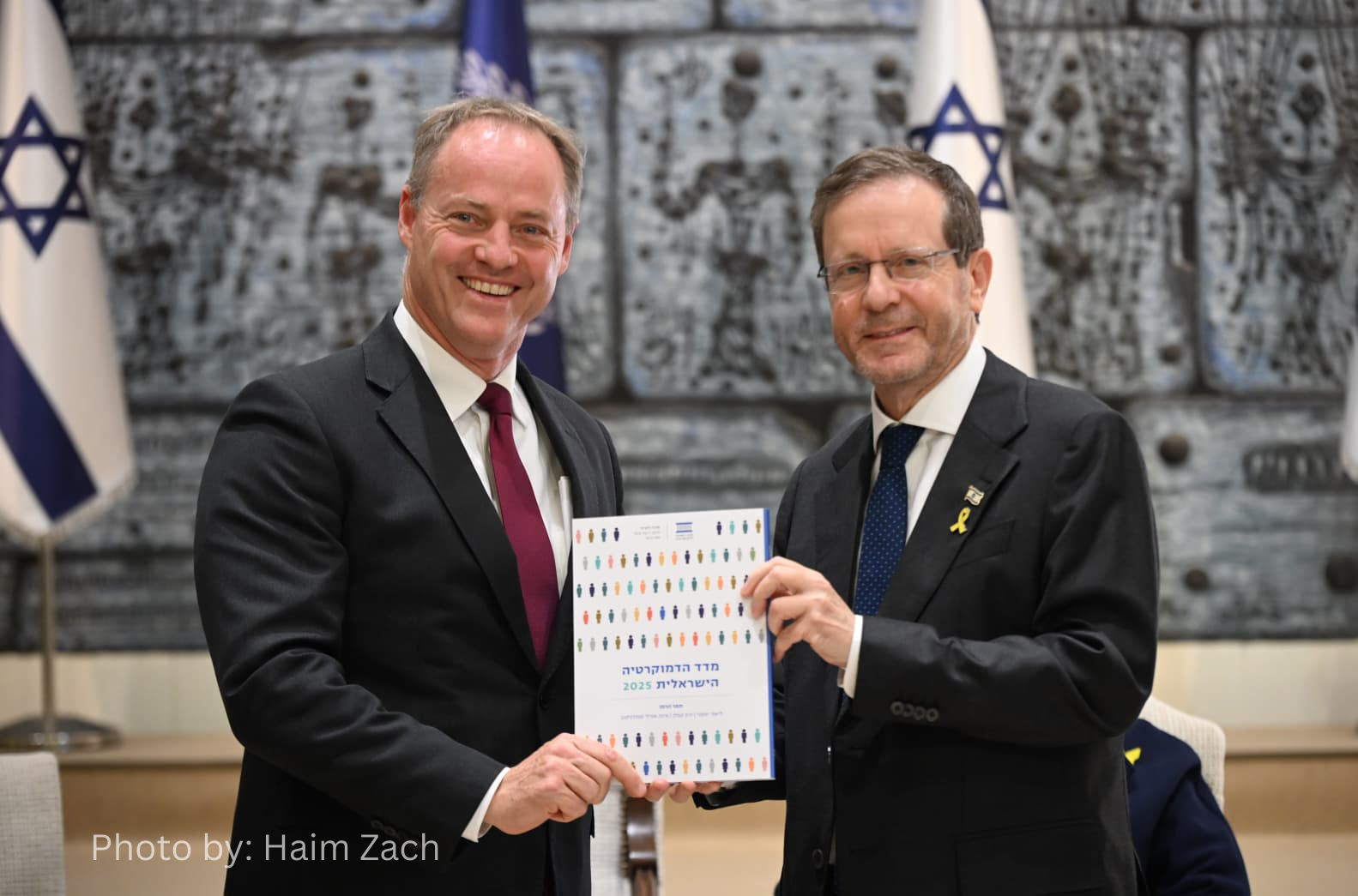
The Israel Democracy Institute publishes today its 2025 Israeli Democracy Index (click here for a summary of findings), based on a large-scale survey carried out in May, parts of which were revisited in November 2025. Yohanan Plesner, President of the Israel Democracy Institute, and Prof. Tamar Hermann, Director of the Viterbi Center for Public Opinion and Policy Research at the Institute, presented the Israeli Democracy Index 2025 today (Monday) to the President of the State of Israel, Isaac Herzog.
The Democracy Index is published for the 23rd consecutive year and outlines a complex picture regarding the public’s assessment of the resilience of Israeli democracy, the level of trust in state institutions, and internal cohesion within society. The Democracy Index 2025 team included: Prof. Tamar Hermann, Dr. Lior Yohanani, Yaron Kaplan, and Inna Orly Sapozhnikova.
A separate press release will be published containing the details of special chapter dedicated to public opinion regarding the upcoming elections.
2025 Israeli Democracy Index
In many respects, the year 2025 in Israel was a continuation of 2024. This continuity explains the considerable similarity between the findings of the 2024 and 2025 surveys. There are similar indications of general dissatisfaction, public trust in various state institutions remain low, and assessments of the level of solidarity in Israeli society are middling to low. At the same time, there are also reasons for optimism: The public’s assessment of Israel’s overall situation has improved; a large proportion of Israelis would prefer to remain in Israel rather than emigrating to another Western country; and the sense of belonging to Israeli society is strong. There has also been little change in Israel’s position in international democracy indicators, despite the worsening of its standing in the international community.
Trust in State Institutions
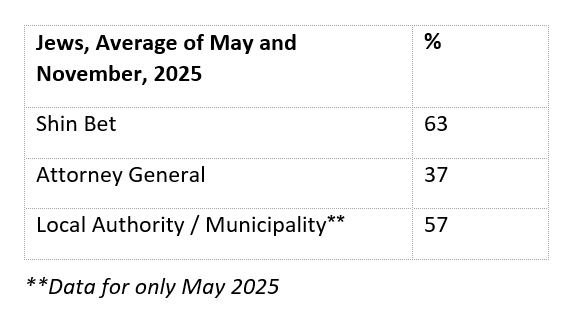
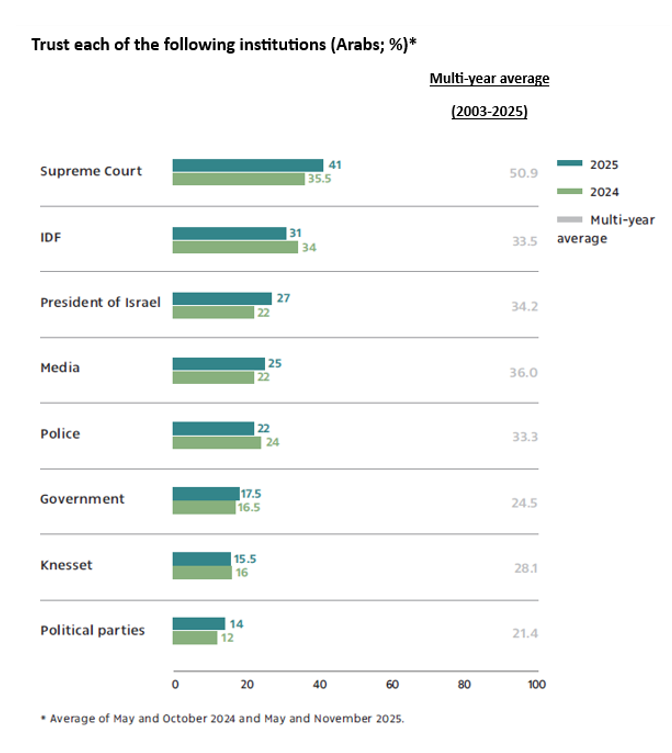
In both the Jewish and Arab samples, the trust rankings for 2025 are quite similar to those from 2024. For almost all institutions, the percentage of respondents expressing trust this year is lower than the multi-year average. Among Jews (and across all political camps), the IDF has the highest trust ratings. Among Arabs, the Supreme Court holds first place.

We also checked trust in each of the following institutions:
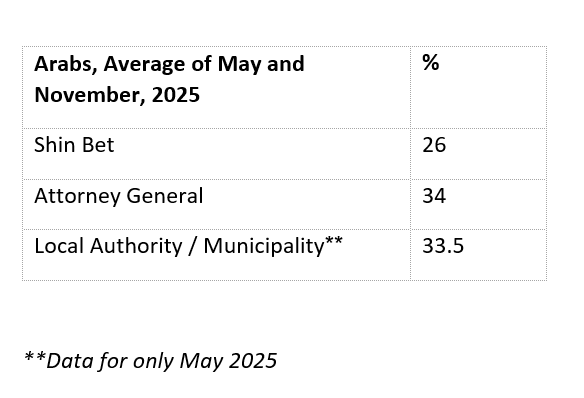
Around half (46.5%) of the total sample agree that “it would be best to dismantle all the country’s political institutions and start over from scratch.”
Israel’s Overall Situation Today
As of November 2025, Israelis are almost evenly split in their assessment of Israel’s overall situation, with similar shares defining it as good, so-so, and bad. This marks a significant improvement relative to 2024 and May 2025, when around one-half of Israelis defined Israel’s situation as bad or very bad.
Jews have a more positive view of the situation than Arabs: In November 2025, 30.5% of Jews classified Israel’s overall situation as bad. By contrast, more than half of the Arab respondents still defined Israel’s situation as bad (52%), though this was a significant improvement from May 2025, when the corresponding share was almost two-thirds (64.5%).
Israel’s overall situation today, 2010–2025 (total sample; %)*
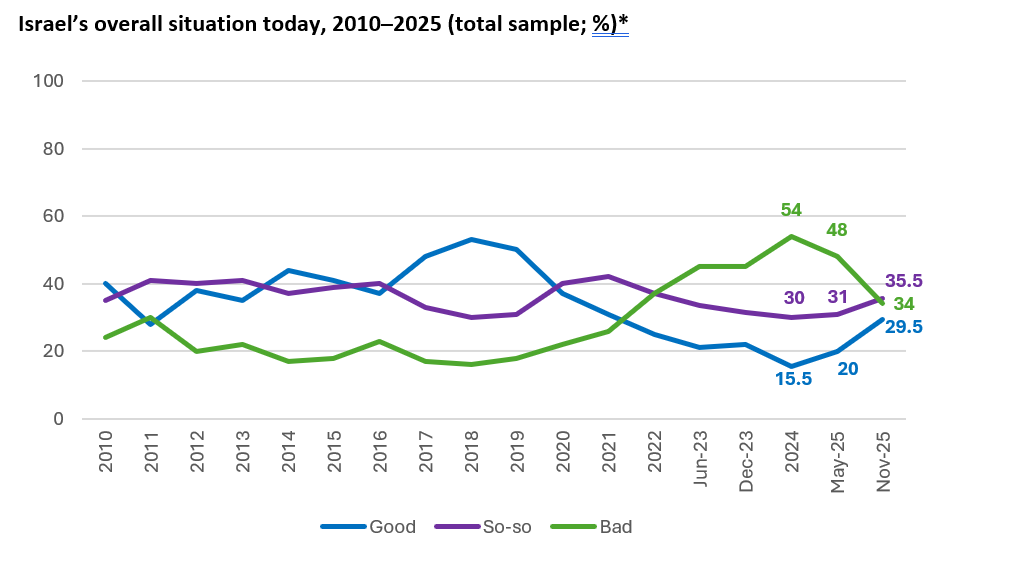
*The two results from 2023 are shown separately to illustrate the impact of the war
A breakdown by political orientation (Jewish sample) shows that on the Left, 65.5% assess the situation as bad, compared to 46.5% in the Center and only 16% on the Right.
Rating Israel’s Democracy
Only about a quarter of Jews today (May, 24%; November, 27%) rate Israeli democracy as good or excellent, continuing the downturn of recent years. In November of this year, the share of Arabs who gave Israeli democracy a positive grade was one of the lowest since we began examining the issue, at just 12%.
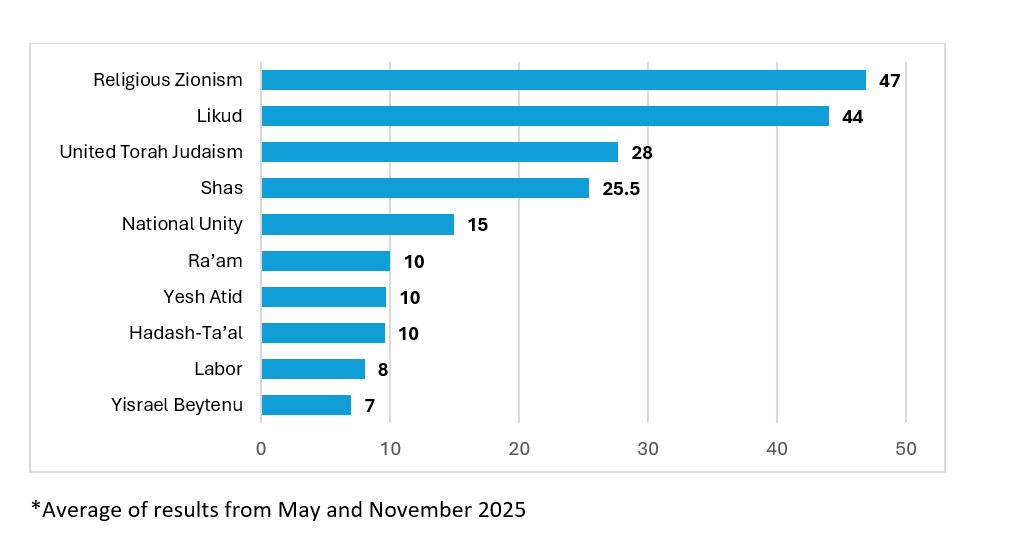
Only a minority in each of the three political camps (Jewish respondents) gives Israeli democracy a rating of good or excellent in 2025 (average data for May and November: Left, 9%; Center, 14%; Right, 34%).
Rate Israeli democracy as good or excellent, by vote in the 2022 Knesset elections (total sample; %)*
Who Can Be Relied On in Times of Trouble?
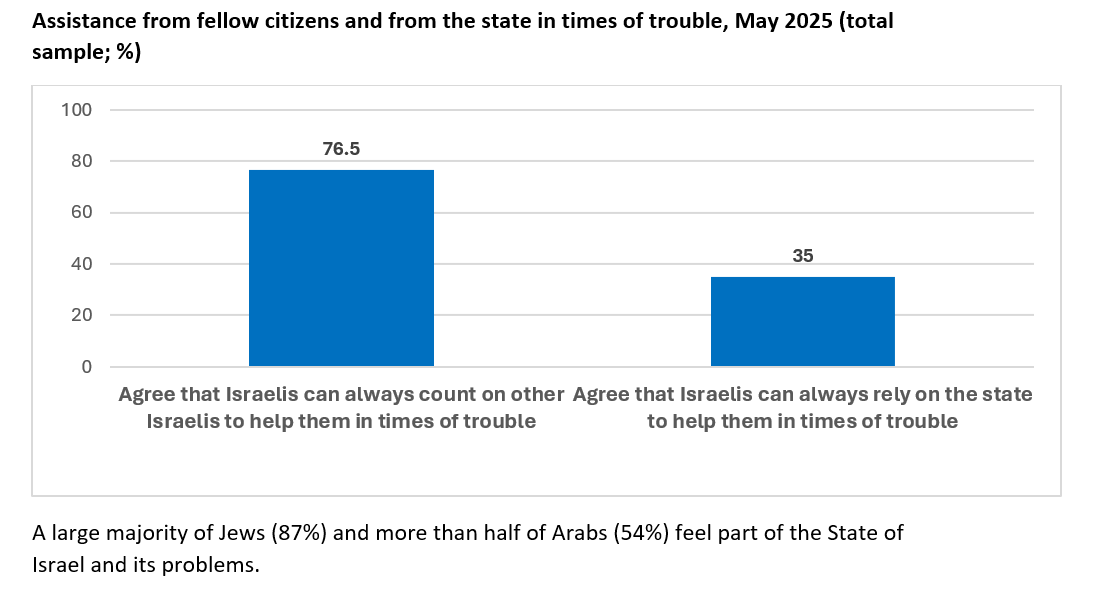
Among both Jews and Arabs, a large majority believe that it is always possible to count on other Israelis to help them in times of trouble. However, only about a third of all interviewees agreed with the statement that Israeli citizens can always rely on the state to help them in times of trouble.
Assistance from fellow citizens and from the state in times of trouble, May 2025 (total sample; %)
Most Acute Social Tension in Israel
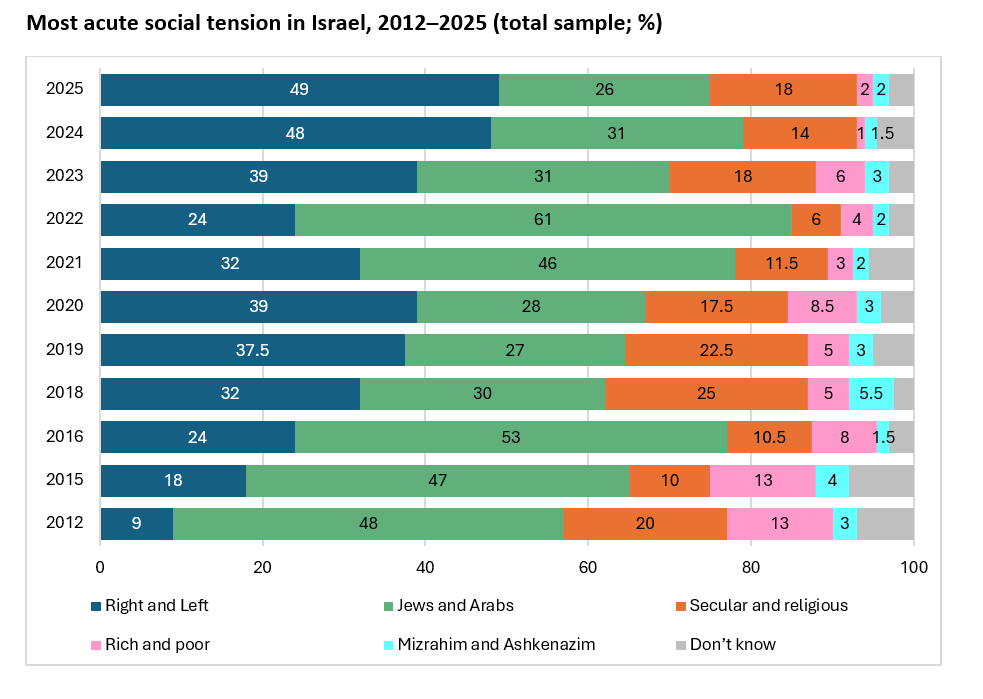
The largest share of Israelis (almost half) say that the most acute social tension in Israel is that between Right and Left. Among Jews, more than half rate this as the most acute tension, with two others tied for second place: the tension between Jews and Arabs, and the tension between religious and secular. Among Arabs, on the other hand, the tension between Jews and Arabs is perceived as the most severe, while the tension between Right and Left ranks second.
To What Extent Does Israel Succeed in Providing for Its Citizens’ Security and Welfare?
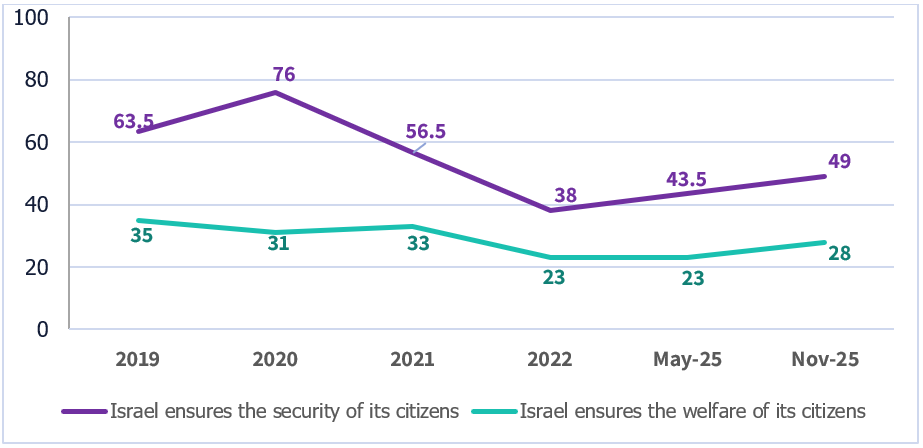
More than half of the Jewish public (53%) said in November 2025 that the country ensures the security of its citizens, a significant increase relative to the May survey results. By contrast, only about a third of Arabs hold the same view. The Israeli public has a much lower assessment of the state’s performance in ensuring its citizens’ welfare: only just over a quarter (Jews, 28%; Arabs, 27%) think that it is succeeding in this task.
Agree that Israel ensures the security and the welfare of its citizens, 2019–2025 (total sample; %)
Fairness of the Upcoming Elections
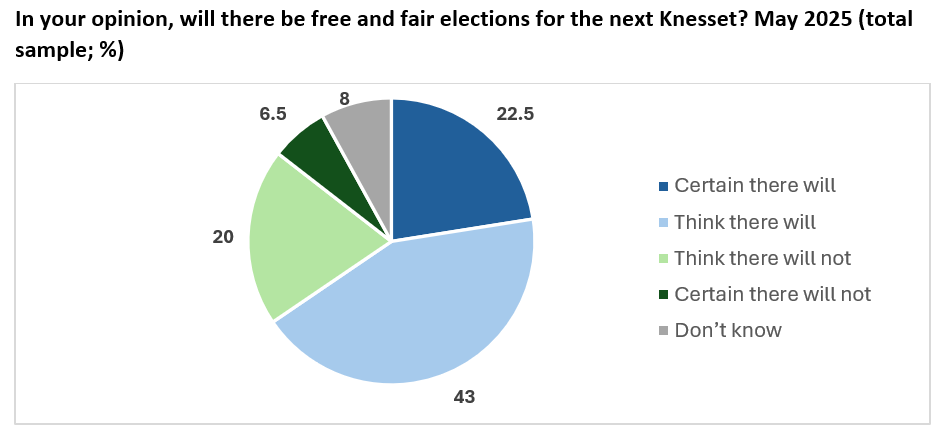
A clear majority of the total sample (65.5%) thinks that the next Knesset elections will be fair and free.
In your opinion, will there be free and fair elections for the next Knesset? May 2025 (total sample; %)
A majority of Israelis feel that there is no party that closely represents their views (Jews, 67.5%; Arabs, 76%).
Including Arab Parties in the Government
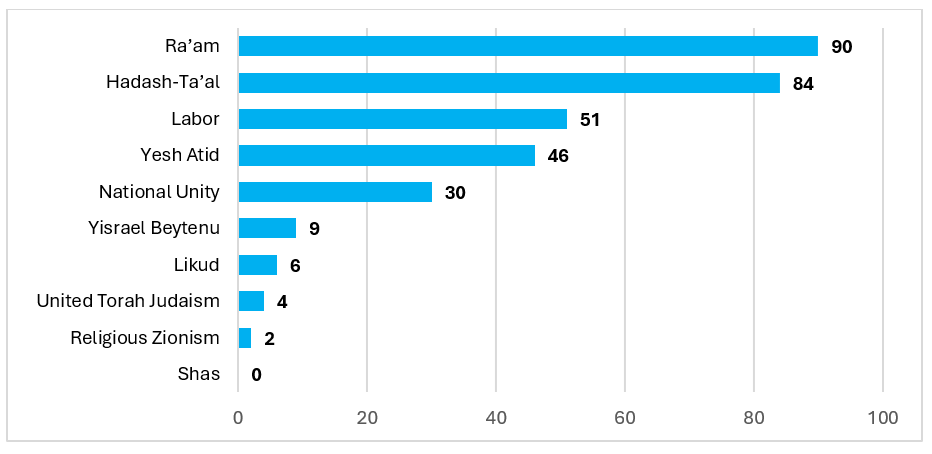
In November, a large majority (77%) of the Arab public supports the inclusion of Arab parties in the government, while a majority (71.5%) of the Jewish public opposes it. In the Jewish sample, a majority on the Left support having Arab parties in government (69%), compared to a small minority in the Center (26%) and a tiny minority on the Right (7%).
Support the inclusion of Arab parties in the government, November 2025 (total sample, by vote in the 2022 Knesset elections; %)
Accordingly, we once again found that the majority of Arabs are in favor of Arabs living together with Jews, while a large proportion of Jews are opposed.
Balance Between the Jewish and Democratic Components in the State of Israel
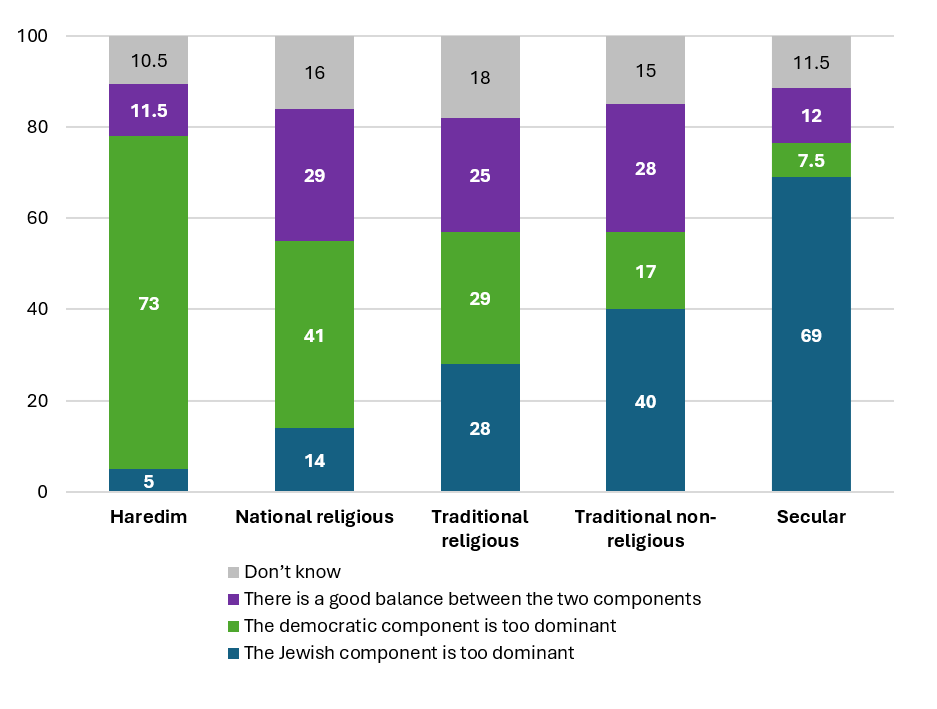
The most common opinion among Jewish respondents is that the Jewish component in the State of Israel is too dominant (44%). Around a quarter (24%) think that the democratic component is too dominant, and approximately a fifth (19%) think that there is a good balance between the two components. A clear majority of secular Jews hold that the Jewish component is too strong, while a clear majority of Haredim believe that the democratic component is too strong.
Is there a good balance today between the Jewish and democratic components of the State of Israel? May 2025 (Jews, by religiosity; %)
State Intervention in Content Broadcast by Public Media Outlets
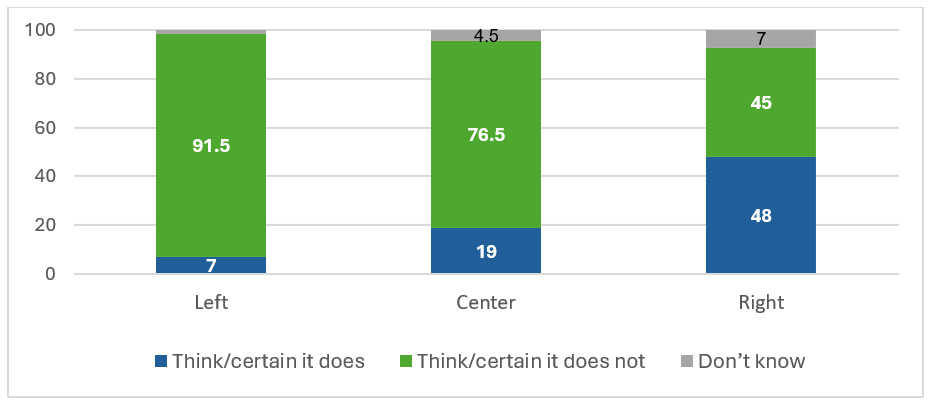
In the total sample, the majority of respondents (61.5%) think that the state does not have the right to interfere in the content of public media outlets despite the state subsidies they receive (Jews, 59.5%; Arabs, 71%).
Does the fact that the state subsidizes public media outlets give it the right to be involved in determining the content broadcast by these media? May 2025 (Jews, by political orientation; %)
Worry About Expressing Political Views
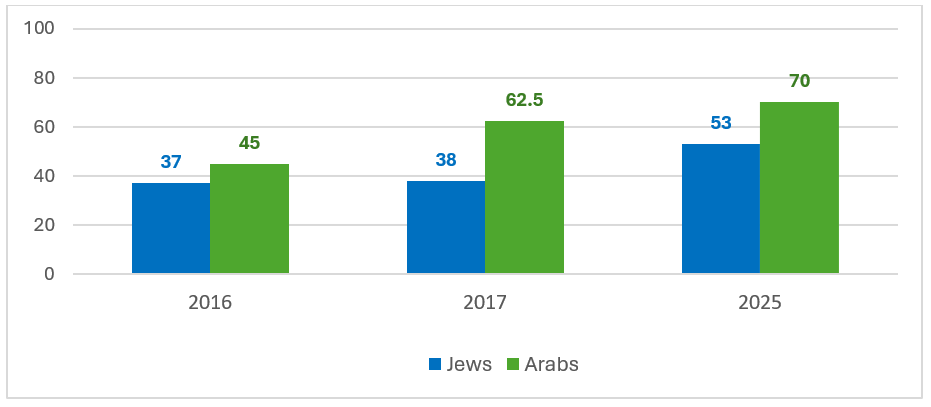
In 2025, the majority of Arabs (70%) and just over one-half of Jews (53%) say they prefer to keep quiet and not express their political opinions in the presence of people they don’t know—a continuation of the upward trend relative to 2016 and 2017.
Prefer to keep quiet and not express their political opinions in the presence of people they don’t know, 2016–2025 (%)
The Need for a Constitution
A large majority (71%) of the general public (Jews – 69%; Arabs – 78%) believe that it’s important for Israel to have a constitution.
To what extent is it important or not important for Israel to have a constitution (%, total sample)
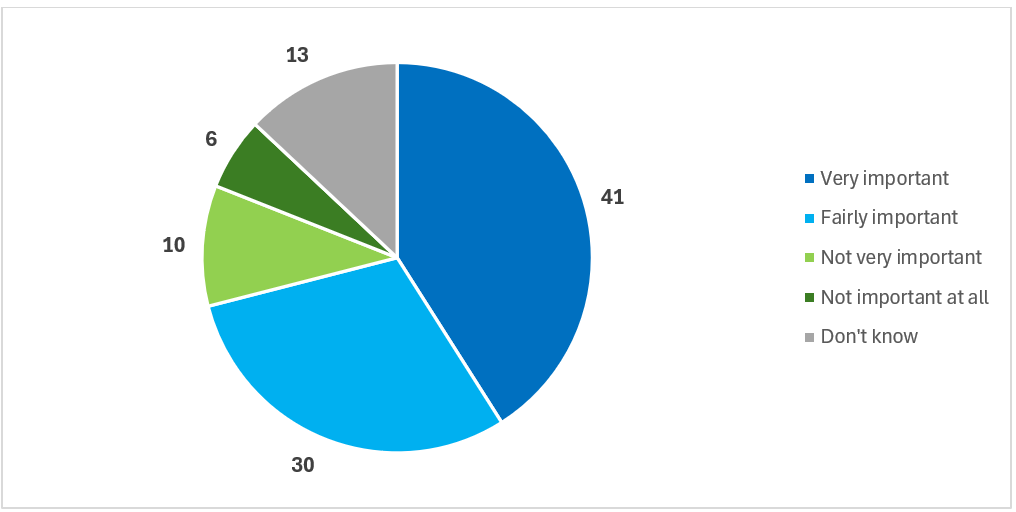
May, 2025
Optimistic/Pessimistic About the Future of Israel
In both May and November 2025, the majority of Jews expressed optimism about Israel’s future, compared to only a large minority of Arabs, which even declined in size between May and November.
Optimistic about the future of Israel (%)
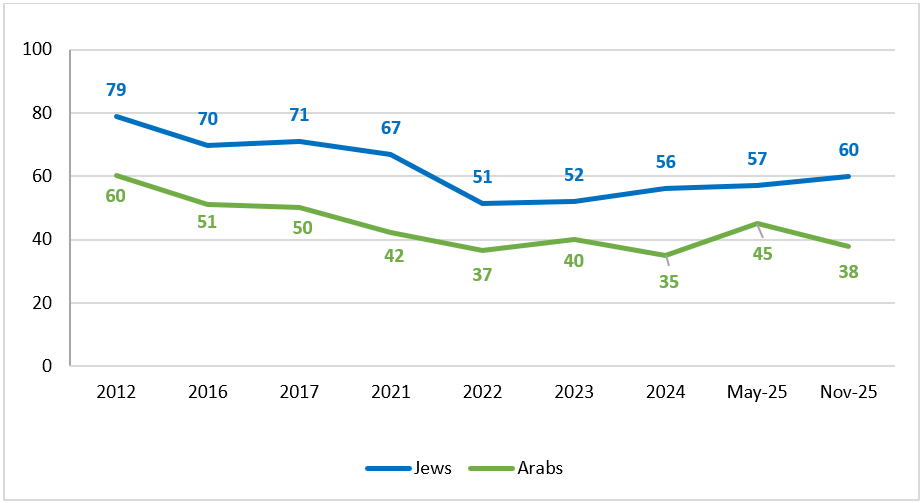
In November 2025, the majority of Jews and approximately one-half of Arabs agreed that Israel is a good place to live. Compared to May 2025, these findings marked an increase among Jews and a decline among Arabs.
Stay in Israel or Emigrate?
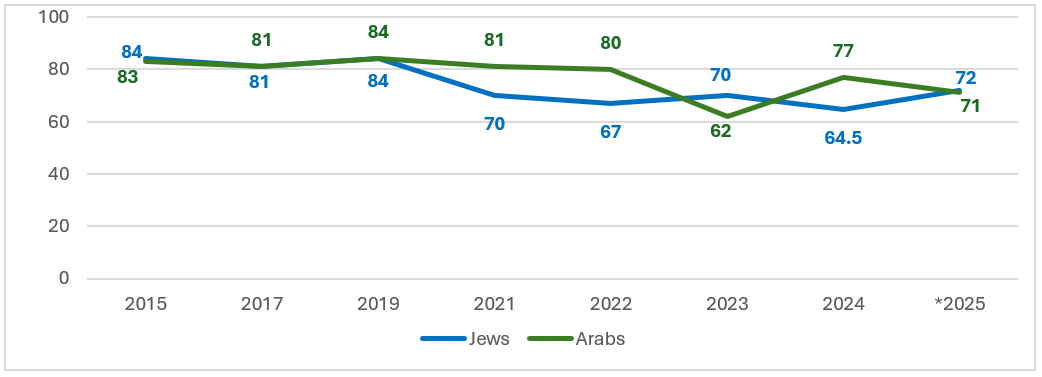
This year, the majority of both Jews and Arabs (more than 70% in both samples) said that they would prefer to remain in Israel even if they were given the opportunity to move to a Western country under favorable conditions.
Prefer to remain in Israel, 2015-2025 (%)
Prefer to remain in Israel (Jews and Arabs, by age group; %)*

Data Collection
The field work for this year’s survey was carried out by Midgam Research and Consulting (interviews in Hebrew via the internet and by telephone, 1,205 Jewish interviewees) and by Afkar Research and Knowledge (telephone interviews in Arabic, 364 Arab interviewees). Interviews were conducted between May 4 and May 28, 2025. The maximum sampling error was ±2.47% at a confidence level of 95%. Validation of some of the findings was carried out in November 2025 by Shiluv I2R Research (interviews in Hebrew via the internet and by telephone, 604 Jewish interviewees) and by Afkar Research and Knowledge (interviews in Arabic via the internet and by telephone, 158 Arab interviewees). The maximum sampling error was ±3.55% at a confidence level of 95%.
The November results are presented here, alongside the findings from May. In certain cases in which the findings from May and from November were similar, we present the average of the two.
The post”IDI Publishes Its Annual Israeli Democracy Index 2025″ is auto generated by Nepalisrael.com’s Auto feed for the information purpose. [/gpt3]
