



NepalIsrael.com auto goggle feed
Hamas has reportedly begun holding leadership elections among its members at a time when the militant Palestinian movement faces imminent decisions which will be critical to its own continued existence and the potential for peace in Gaza.
According to the BBC and press reports in the Gulf, Hamas members in Gaza have already voted. Those in the West Bank, in Israeli prisons and the diaspora are also expected to cast ballots for delegates to the movement’s 50-member general Shura council, which ultimately chooses its politburo and a new interim leader. The process could last weeks.
The new leader will have to decide how far to cooperate with a US-sponsored peace plan, whether to disarm and how much of its arsenal to give up, what to demand in return from Israel in terms of withdrawal from the territory and whether to press for inclusion in a new Gaza government or fade into the political background.
Much of the Hamas leadership has been killed by Israel in a military campaign that also razed much of Gaza and killed more than 75,000 Palestinians over 28 months.
Among those killed was Yahya Sinwar, the Gaza Hamas leader, and Mohammed Deif, its military chief who led the shock attack on southern Israeli communities in October 2023, killing about 1,200 people, including more than 800 civilians.
Israel also assassinated the movement’s deputy leader, Saleh al-Arouri, in Beirut in January 2024 and the overall political leader, Ismail Haniyeh, in Tehran in July 2024. Israel tried to kill much of the surviving leadership in a single airstrike on Doha in September last year when they had gathered to discuss a US peace proposal, but the key leaders survived.
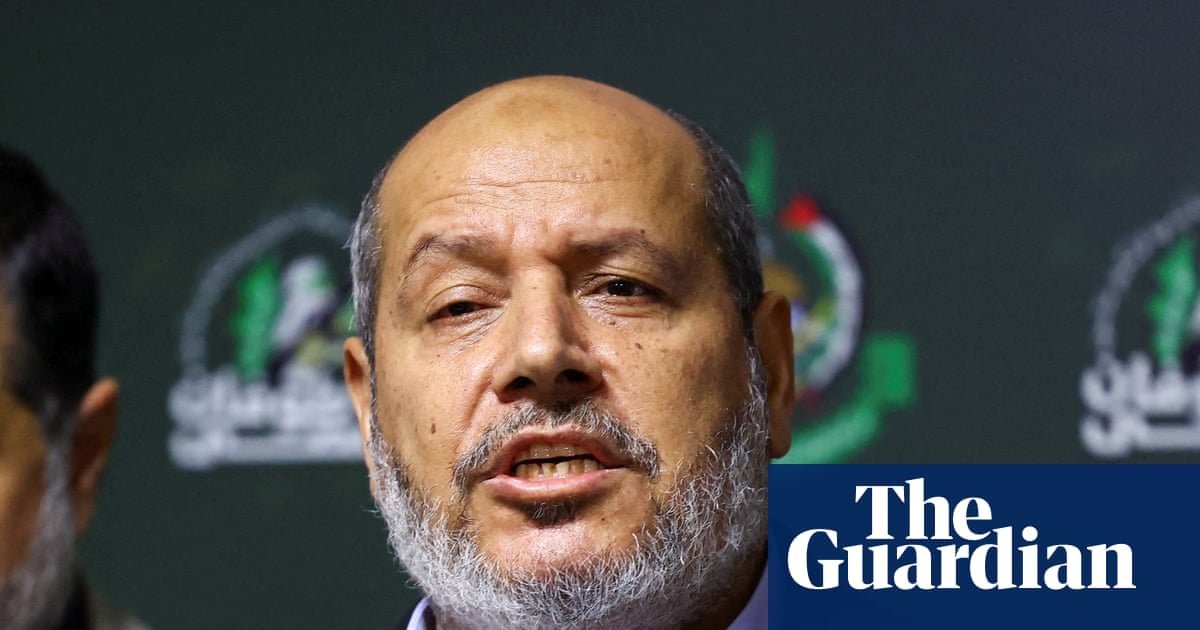
The two frontrunners in the leadership contest are thought to be Khalil al-Hayya and Khaled Meshaal, who both survived the Doha airstrike. Between them, they present a fairly clearcut choice on Hamas’s future direction.
Al-Hayya leads the Gaza wing, though he lives in the Gulf, and is considered Sinwar’s heir – hardline, though not drawn from the military wing, and closest to Iran among Hamas’s foreign sponsors.
Meshaal is a Hamas veteran, one of its founders, who served as overall leader for more than two decades. He now leads the movement abroad and is thought to live in Doha. He is viewed as being at the more flexible end of the Hamas spectrum, with stronger ties to Qatar and Turkey.
“Meshaal wants to consider a political settlement with Israel – not a recognition but maybe a long-term settlement – and even reconciliation with the Palestinian Authority, and once again be part of the formal political system in the Palestinian arena,” said Michael Milshtein, a former Israeli military intelligence colonel now at Tel Aviv University.
“These two represent two different camps, and different agendas about the future and the goals of Hamas.”
It is unclear whether there are other significant candidates. The vote is taking place under conditions of maximum secrecy due to the danger of assassination faced by anyone identified as playing a leading role in Hamas.
“Whoever is in the leadership – whether it’s the Shura council or the actual top leadership – the question is: who wants to be in that position, knowing that they will most likely be on an Israeli hitlist?” said Khaled Elgindy, a senior research fellow at the Quincy Institute for Responsible Statecraft in Washington.
“It’s clear that this is going to be a new chapter for Hamas, and it may even be existential. Will Hamas survive? What will it look like? Obviously, they’re going to do anything and everything to avoid the optics of a surrender,” Elgindy said.
“Meshaal will have better ties with the Arab states, certainly with the Qataris and the Turks, all of whom are going to be very influential,” he added. “I can see him making the case that Hamas’s reliance on Iran is going to have to diminish as Tehran is preoccupied with its own survival.
“There’s so much anger and frustration with Hamas on the street, but has that translated to the membership, the people who are actually voting? I don’t have a sense of that.”
Under Donald Trump’s plan, a group of non-affiliated Palestinian technocrats, called the National Committee for Administration of Gaza (NCAG), are supposed to take over the immediate task of running Gaza, and overseeing Hamas’s disarmament.
While Hamas leaders are reported to have indicated informally they would consider handing over heavier weapons, such as rockets and mortars, to a Palestinian body, its fighters are likely to refuse to surrender personal firearms, which they say are necessary for self-defence against Gaza’s multiple armed clans and criminal gangs, some of them backed by Israel.
Reuters news agency has reported that Hamas has been busy rebuilding its organisation in recent weeks, collecting taxes on goods allowed into the territory under a ceasefire deal and replacing senior officials in Gaza ministries and district governors.
The post”Hamas reportedly holds leadership vote at critical moment for militant group | Hamas” is auto generated by Nepalisrael.com’s Auto feed for the information purpose. [/gpt3]
