



NepalIsrael.com auto goggle feed
Released hostage Arbel Yehoud told The Daily Mail that she was sexually assaulted “almost every single day in captivity” in a Friday interview.
She noted that she did not wish to go into the details of the abuse, but shared that it was so significant and repeated that it made her want to end her own life.
“I tried to end my life three times,” Yehoud said. “I felt like I couldn’t go on. There were moments when I thought it was the only way out.”
However, her love for her partner, former hostage Ariel Cunio, and protests at Hostages Square kept her going. In the crowds, she saw signs of herself, Cunio, and other people she knew from Nir Oz. “From the moment I saw that, I didn’t try to end my life on my own there,” she told N12 in a separate Friday interview.

“I had a very strong intention and desire to hold on to this thing of mine until Ariel comes back, because he is the person closest to me and the one I want to share it with and tell it to, and we are both not there yet. It is very hard,” she said.
“I so deeply appreciate and admire the hostages who manage to sit and open their mouths and tell, and open their trauma,” she said, adding that Romi Gonen’s testimony changed her feelings on the matter. “Until then, I suppressed it well; I held it together well.”
“I identified with many of the things she said there, in terms of the gap she felt when she met the girls in the tunnel, when each one told what she had been through,” Arbel explained. “But even after I was able to see the horrors Romi had to endure, the gap remained. Because it is a very, very long time, and the things I went through, I went through from beginning to end, so they are in a closed, closed suitcase.”
Ariel Cunio, Arbel Yehoud, reflect on October 7 massacre
Yehoud and her partner, Cunio, spoke to N12 about their relationship, their time as hostages, and their attempts at recovery.
“I’ve known Arbel my whole life,” Cunio said about the start of their connection. “Since I was born. We were neighbors.”
The two started dating in 2018. Five years later, on October 7, they were kidnapped from their home in Nir Oz by terrorists, taken into Gaza, and separated.
“We held hands, he said something, I said something, we said ‘Our life is gone,'” Yehoud recalled.
Cunio added, “I told her, ‘The most important thing is that we stay together. As long as they don’t split us apart, we’re ok.’ Half an hour later, that’s what happened.”
“I didn’t even get a chance to say bye, couldn’t even look him in the eyes,” Yehoud said.
Both were taken by Palestinian Islamic Jihad terrorists, and kept in separate locations – Yehoud in a house, and Cunio, after initially being brought to a different house, in an empty space in the ceiling of a store.
“I was there for three and a half months, bent over all the time,” he recounted. “Windows closed, door closed all day, it got so warm you could barely breathe.”
Cunio was also forced to remain silent in his hiding space, under threat of being given over to Hamas.
Exchanging letters through their captors
The couple developed a way to stay in contact during part of their captivity.
“After a few days of pressuring them for information about Arbel, they offered to let me write her a letter,” Cunio said.
“I was in shock from the first letter,” Yehoud said, “They told me he drove them crazy.”
Their captors ferried letters and notes back and forth between the couple, although they were never allowed to have any contact in person. After only a couple of months, however, the notes became shorter, as their captors allowed them to write only a sentence or two. Soon after, they were told there would be no more letters.
“His last letter was a short note,” Yehoud remembered, “But he was able to fit some sort of code in it, and that’s how I learned that my notebook was with him.”
Yehoud had filled a notebook with drawings and doodles from her first 50 days as a hostage. Cunio’s captor had given him the notebook, he said, in order to keep him calm.

“She wrote prayers, dreams she had,” Cunio recalled, “I was on almost every page. There were whole pages with hearts with my name and ‘My Ariel.'”
Cunio was able to keep Yehoud’s notebook with him until the end of his captivity, when Hamas refused to allow him to take it back to Israel.
Despair leading to suicidal thoughts
Both of them struggled to maintain hope, diving into thoughts of self-destruction and suicidality.
Cunio also had moments of despair. “Sitting by yourself for so long drives you crazy,” he said. “I had times when I said ‘Come on, drop a bomb on me and that’s it.’ Like, get this saga over with already. Like, ‘Come on, shoot me in the head.’ I used to tell my captors, ‘Shoot me, end this.'”
All his kidnappers would respond with was, “It’ll be alright. Gilad Schalit was held for five years; in the end, they freed him in exchange for a thousand terrorists. You’ll be released.”
Yehoud was released at the end of January 2025, after 482 days. Cunio was given a chance to see her release in a video on Telegram that his captor showed him. “This giant boulder, which was on my heart, simply vanished,” he said.
Yehoud also caught a glimpse of Cunio on video, just a few days before she was freed. In a tunnel below Gaza, she was able to spot Cunio, pale and holding a sign with the date and his details, in a video that terrorists were watching.
“I had to keep a poker face up so that I wouldn’t agitate things down there,” she said. “He looked completely pale, white, but I got here with something to tell his parents.”
Cunio was released in October 2025, two years after he was abducted.
“They prepared me, told me at three-four in the morning that they were transferring me to Hamas,” he recalled. He had a last conversation with one of his captors, who told him, “You look like a good guy, it’s a shame you’re a Jew. Why not convert to Islam?”
“Why?” Cunio asked.
“Because if you convert to Islam, you won’t go to Hell, you’ll go to paradise,” his captors answered.
“Ah,” Cunio said. “So you think those Hamas members who came in and murdered and raped and slaughtered and burnt all the kibbutzim, they all went to paradise?”
“Yes,” the captor told Cunio.
Hostage couple finally reunited
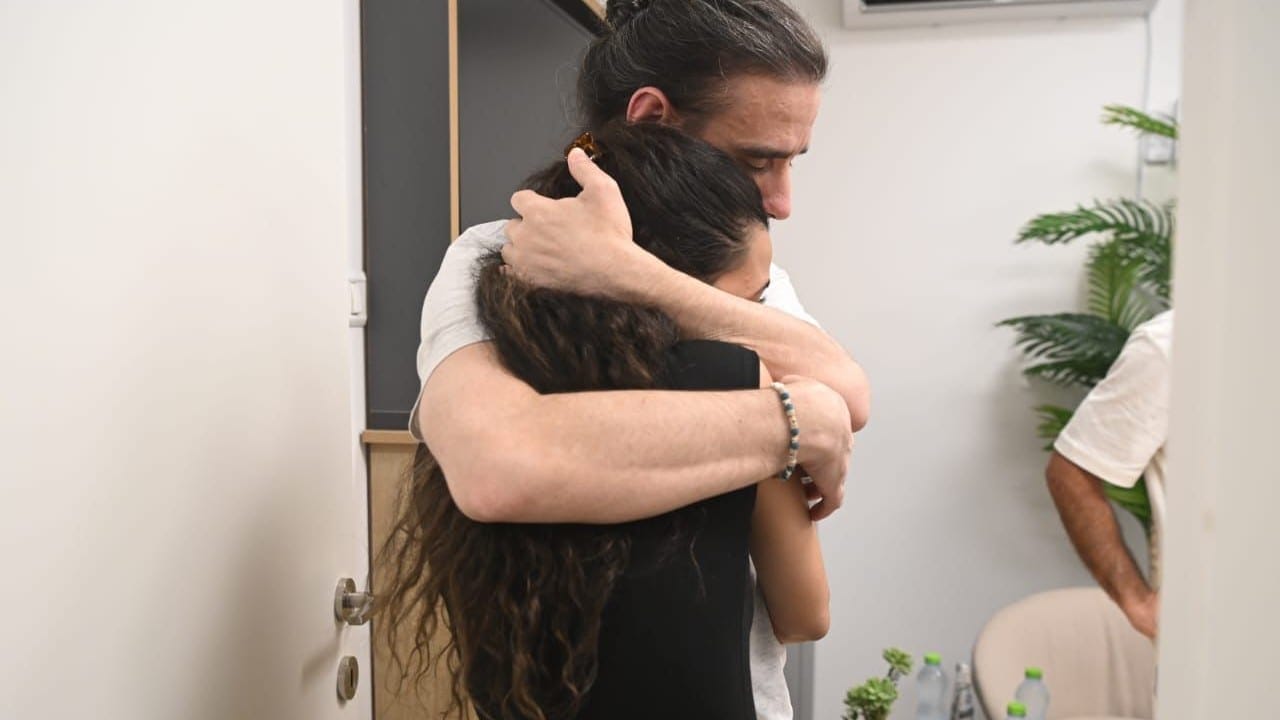
When the couple finally reunited, they had no words.
“I don’t think we spoke during that first meeting, only afterwards,” Yehoud added.
But after the joy of the initial meeting, Cunio and Yehoud faced lingering challenges and struggles from their extended time as prisoners.
“Waking up in the morning, after being imprisoned, everything is strange,” Cunio described. “There are times when I’ll go for a walk with the dog, and I’ll see the sky and the plants, and suddenly this feeling of freedom hits me, that I can do whatever I want.”
Yehoud described her emotions and memories of her time in Gaza as being like a closed suitcase. “We’re both not there yet,” she said about the difficulties in talking openly with Cunio about the traumas they’d been through. “I have so much respect and appreciation for the hostages who are able to sit down and open their mouths and tell their stories.”
Cunio also said he was afraid that the hostages would be forgotten after a few years, “like Holocaust survivors.” When asked whether any ministers had called to welcome them home, the couple said that nobody had.
But the two ex-hostages also expressed strong hope in their mutual ability to support each other, to rise above the trauma they’d experienced, and build a family together.
“We’ll try to get closer to the life we had before October 7,” Yehoud concluded, “with a clear understanding that it can never be the same. But to try to approach it – a simple, modest life, a house that’s ours, that we can raise a family in. I can sit here for hours and cry, and it’s difficult, but in the end – I’m here.”
The post”Ex-Gaza hostage: I was sexually assaulted almost every day” is auto generated by Nepalisrael.com’s Auto feed for the information purpose. [/gpt3]
