



NepalIsrael.com auto goggle feed
Last month, the Trump administration announced the start of the second phase of its Gaza peace plan, which the UN Security Council endorsed in November. Phase one, which went into effect last October, produced an initial cease-fire and ultimately the return of all hostages alive and dead, the release of about 2,000 Palestinian prisoners, and the resumption of humanitarian aid. Phase two mandates the creation of a technocratic Palestinian governing authority, the deployment of an international stabilization force, the disarmament of Hamas, the reconstruction of Gaza, and the withdrawal of the Israel Defense Forces. The success of phase two will depend on the disarmament of Hamas. If there is disarmament, there will be reconstruction and Israeli withdrawal. Without it, there will be neither. The success of phase two hinges on the answer to a central question: Can the conditions that produced years of terrorism and war truly be dismantled?
At present, there are effectively two Gazas that must be unified before a durable peace can take hold. Israel maintains control of what is known as the Green Zone, which is roughly 53 percent of the territory and is largely in the east. Hamas controls the so-called Red Zone, the remaining 47 percent, primarily in the western part of the strip. In a statement issued in October, Hamas formally agreed to “hand over the administration of the Gaza Strip to a Palestinian body of independent technocrats,” but it is far from clear that the group will lay down its arms and allow Gazans to build a future it does not dominate. Achieving that outcome will require multiple actors, led by the United States, to use their leverage.
U.S. President Donald Trump must make clear to three countries in particular—Egypt, Qatar, and Turkey—that they are expected to deliver disarmament or risk damaging their relationships with Washington. The heads of state of all three countries have joined Trump’s Board of Peace and endorsed his Gaza peace plan. Each has influence over Hamas’s finances, legitimacy, political standing, and internal cohesion. Together, they have the power to pressure Hamas to begin decommissioning its weapons. They can publicly condemn the group for blocking the reconstruction of Gaza, and they can threaten to deny its leaders the ability to continue operating in their countries.
If a process of disarmament takes hold, Trump’s peace plan, including a pathway to Palestinian self-determination and statehood, will begin to look less aspirational and more realistic. That may seem implausible today, but successful implementation of phase two would fundamentally alter the psychological and political landscape for both the Israelis and the Palestinians.
Conversely, if Hamas chooses not to disarm and Gaza does not reunify, the future looks bleak. At best, the territory will remain partitioned, with Gazans living under Hamas’s tyranny or Israeli occupation. At worst, Gaza will once again become a war zone.
INTO THE RED ZONE
UN Security Council Resolution 2803 gives the Board of Peace exclusive authority over the governance of Gaza for the next two years, with the possibility of extension. The Board of Peace’s executive committee will work closely with the National Committee for the Administration of Gaza, which is made up of 15 Palestinian technocrats. The NCAG will manage day-to-day governance in both the Green and Red Zones. An International Stabilization Force will back a Palestinian police force that recently underwent training in Egypt and Jordan; together they will assume responsibility for law and order. (The number of countries and the exact mandate and rules of engagement for the ISF are not yet finalized.)
The fate of phase two hangs on what happens in the Hamas-controlled Red Zone. This area is crucial because it contains more than 95 percent of Gaza’s population and most of its urban centers, with the notable exception of Rafah near the Egyptian border. The members of the NCAG, all of whom are from Gaza, have indicated that their mission is to bring stability and economic development to all of Gaza. Should they neglect the Red Zone, they will fail to consolidate their authority and credibility.
But for the NCAG to be able to work in the Red Zone, it will need security—and that cannot be guaranteed unless Hamas disarms and the ISF-backed Palestinian police force can operate unimpeded. In October, Hamas endorsed Trump’s peace plan, but the group’s leadership did not explicitly commit to disarmament, stating that certain unnamed issues (presumably disarmament among them) would be deferred until they can be “discussed within a comprehensive Palestinian national framework.” Perhaps that was meant to provide Hamas an out, but there should be no doubt about point 13 of Trump’s peace plan: “All military, terror, and offensive infrastructure, including tunnels and weapon production facilities, will be destroyed and not rebuilt.” It is very clear that disarmament and demilitarization are required, and there will be monitoring to ensure it.
In theory, Hamas leaders should not be able to oppose the redevelopment and reconstruction of Gaza, since they have already indicated that they are prepared to relinquish administrative control to technocrats. Still, the danger is that Hamas will never entirely abandon control, the NCAG will never fully take charge, and the two will maintain an uneasy cohabitation indefinitely. Although Hamas claims it will not interfere with the NCAG’s work, the history of the contemporary Middle East has repeatedly shown that those who control the weapons often control the outcomes.
A QUESTION OF MEANS
For its part, Israel will not withdraw to the perimeter of Gaza and permit reconstruction, as it is obliged to do eventually under the terms of Trump’s cease-fire plan, unless Hamas first disarms. Without disarmament, there can be no reconstruction, in part because Israelis fear that Hamas will divert materials such as cement, wiring, and steel to rebuild its tunnel system, where it stored and produced the bulk of its weapons, and in part because the Saudis and Emiratis have made clear that they will not invest in reconstruction if Hamas is not disarmed.
At a televised cabinet meeting in January, Trump expressed optimism, saying that “it looks like they’re going to disarm.” His envoy Steve Witkoff added, “They will because they have no choice. . . . They’re going to give up their AK-47s.” According to U.S. and other officials, Qatar and Turkey have recently conveyed to Washington that Hamas will, in fact, begin a process of decommissioning their weapons.
Israeli officials do not share the Trump administration’s optimism. They point to Hamas’s ideological commitment to rejecting Israel’s right to exist. And although a senior Israeli official conceded that Hamas might stage a symbolic gesture, perhaps decommissioning a limited number of heavy weapons, he insisted that the group will never relinquish its ability to reassert control by force. Moussa Abu Marzouk, a veteran senior official of Hamas, seemed to validate the Israeli view in an interview in Al Jazeera in late January, declaring that Hamas had not agreed to disarm. He said such a commitment “never happened,” adding that “not for a single moment did we talk about the surrender of weapons.”
Standing beside Israeli Prime Minister Benjamin Netanyahu at Mar-a-Lago several weeks ago, Trump warned that it would be “horrible, horrible” for Hamas if it did not disarm. Trump has from time to time threatened to impose a deadline on Hamas to disarm. If he follows through on that threat and the group fails to decommission its weapons, Israel will have the green light from Washington to act militarily.
The United States and Israel agree on disarming Hamas but disagree on how to do so. Netanyahu doubts that disarmament can happen peacefully. Trump is at least willing to test the proposition. If Trump does announce a deadline, with the implication of renewed Israeli military action, that will make clear to Hamas’s leadership (and everyone else) that there is a limit to Washington’s patience.
COLLABORATIVE ADVANTAGE
For Trump’s preferred approach to work, Washington will have to lean on Egypt, Qatar, and Turkey. Each of these countries has significant bilateral interests with the United States, and each has been keen to show Trump that maintaining good relations serves the United States’ interests. The U.S. president appears to share that desire. He has approved the inclusion of Qatar and Turkey, whose negotiators helped secure the release of Israeli hostages, in the Board of Peace’s executive committee, over Netanyahu’s opposition. (Israel opposed their inclusion because of their long-standing support for Hamas.)
Egypt, Qatar, and Turkey also have the means to pressure Hamas to disarm. Egypt controls Hamas’s access to Gaza through the Rafah crossing. Hamas officials and their families live in Qatar with impunity guaranteed by Trump after Israel’s failed strike in September. Qatar can threaten to expel them and deny them access to their bank accounts—and Turkey can make clear it will not take them. The three countries can use their individual and collective leverage on Hamas, impressing on the group that if it does not disarm (and allow the NCAG to begin rebuilding in the enclave), the fault will lie with Hamas’s leadership. They will need to insist that the group not only decommission its weapons but also provide maps of their tunnels, so that this infrastructure could be destroyed.
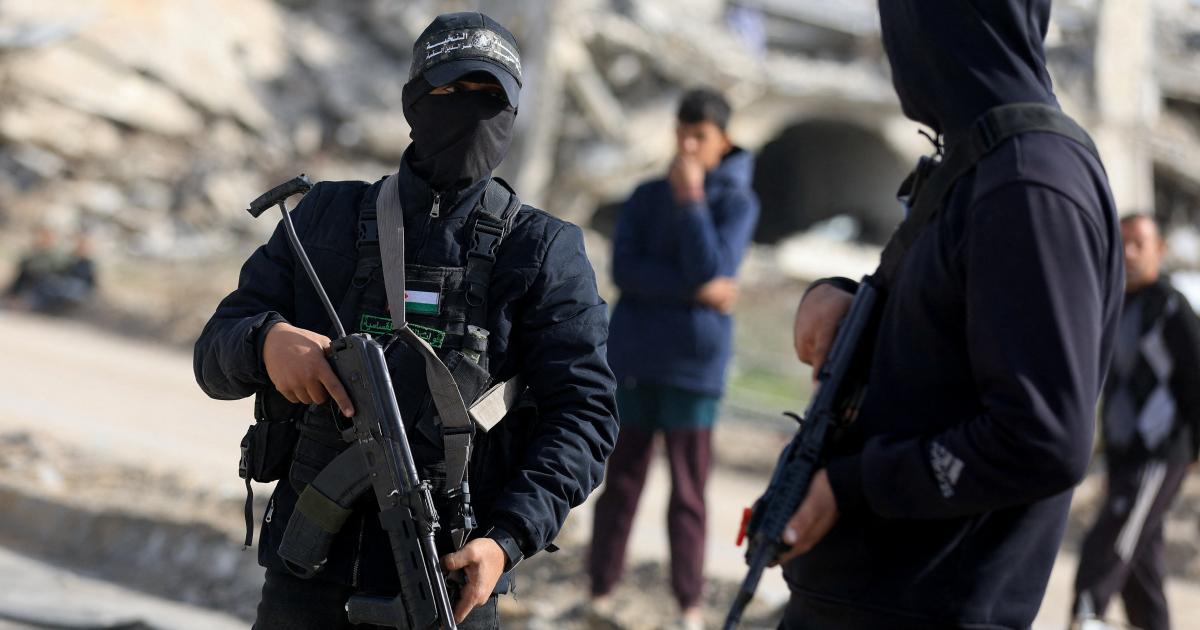
They must pressure Hamas to surrender its weapons to either the ISF or the NCAG’s police contingents. Disarmament should begin with heavy weapons that directly threaten Israel: rockets, mortars, antitank missiles, machine guns, and rocket-propelled grenades. Mike Waltz, the U.S. ambassador to the United Nations, has said that decommissioning will also involve buy-back provisions and amnesty for those who turn over their weapons. Crucially, the group’s AK-47s must be included in any disarmament process, lest Hamas maintain its means of coercion over the Gazan population and prevent the new ISF-backed Palestinian security forces from ensuring basic law and order.
THE CLOCK IS TICKING
Israel, too, will need to play a constructive role in implementing phase two, and that starts with permitting the NCAG to operate and facilitating the rapid entry of aid, especially prefabricated housing and medical supplies. Beyond that, if Hamas engages in a credible disarmament process, Israel must permit reconstruction to begin at least in the places in the Red Zone where disarmament has taken place. Eventually, as Hamas demonstrates significant progress on disarmament, Israel will have to pull back its forces in accordance with Trump’s peace plan.
Just as the disarming of Hamas will unfold in stages, so, too, will Israeli withdrawal from Gaza. Netanyahu will be skewered within his coalition and beyond if he is seen as withdrawing before disarmament, facing accusations that he has left Israel vulnerable after a sustained military effort. Knowing that any withdrawal is likely to cost him his coalition and require him to go to early elections, he is likely to resist Trump. But the fact is, he cannot easily say no to the president.
Trump has already demonstrated his ability to apply leverage to Netanyahu. In June, he insisted that Netanyahu recall aircraft midflight to preserve the cease-fire that ended Israel’s 12-day war with Iran. In September, after a failed Israeli attempt to assassinate Hamas officials in Doha, Trump secured Israel’s acceptance of his peace plan and compelled Netanyahu to apologize for the attack to Qatar’s prime minister in a phone call from the Oval Office. And last month, he overrode Netanyahu’s opposition to include the Turkish foreign minister and a senior Qatari official on the executive committee of the Board of Peace. Increasingly, it appears that Netanyahu cannot afford to defy Trump—especially after repeatedly calling him Israel’s greatest friend and with elections looming.
Can the conditions that produced years of terrorism and war truly be dismantled?
Even so, Israel will not withdraw any farther than it has already before there is meaningful progress on Hamas’s disarmament. That is why Trump must reach an understanding with Netanyahu on what would constitute meaningful progress—and if Hamas does indeed voluntarily disarm, Trump must hold Netanyahu to his own commitment to pull back.
Ultimately, the question is whose clock is ticking with a greater sense of urgency. Israel has made clear that if voluntary disarmament fails, military action will follow. Israeli officials privately speak of March—six months after the cease-fire—as a decision point. That gives Egypt, Qatar, and Turkey limited time to push Hamas to begin a real disarmament process. If Trump wants the cease-fire he has achieved in Gaza not only to endure but to also evolve into something more durable, he will have to apply sustained leverage—on Hamas, on Israel, and on the regional states that have influence.
Leverage, like any strategic asset, erodes if it is not used to produce concrete outcomes. The coming weeks will show whether diplomacy can shrink and ultimately eliminate Hamas’s zone of control, avert another war, and catalyze a transformation in Gaza. If Trump wants the Board of Peace to act in other conflicts, he will first need to show that it has succeeded in Gaza.
Loading…
The post”Peace Through Leverage in Gaza” is auto generated by Nepalisrael.com’s Auto feed for the information purpose. [/gpt3]
